HAMi vGPU 原理分析 Part4:Spread&Binpack 高级调度策略实现
上篇我们分析了 hami-scheduler 工作流程,知道了 hami-webhook、hami-scheduler 是怎么配合工作的。
HAMi vGPU 原理分析 Part3:hami-scheduler 工作流程分析
本文为 HAMi 原理分析的第四篇,分析 hami-scheduler 在调度时是如何选择节点的,即:Spread、Binpack 等高级调度策略是怎么实现的。
这篇文章我们解决最后一个问题:Spread、Binpack 等高级调度策略是怎么实现的
以下分析基于 HAMi v2.4.0
这里在贴一下上一篇总结的 HAMi Webhook、Scheduler 工作流程:
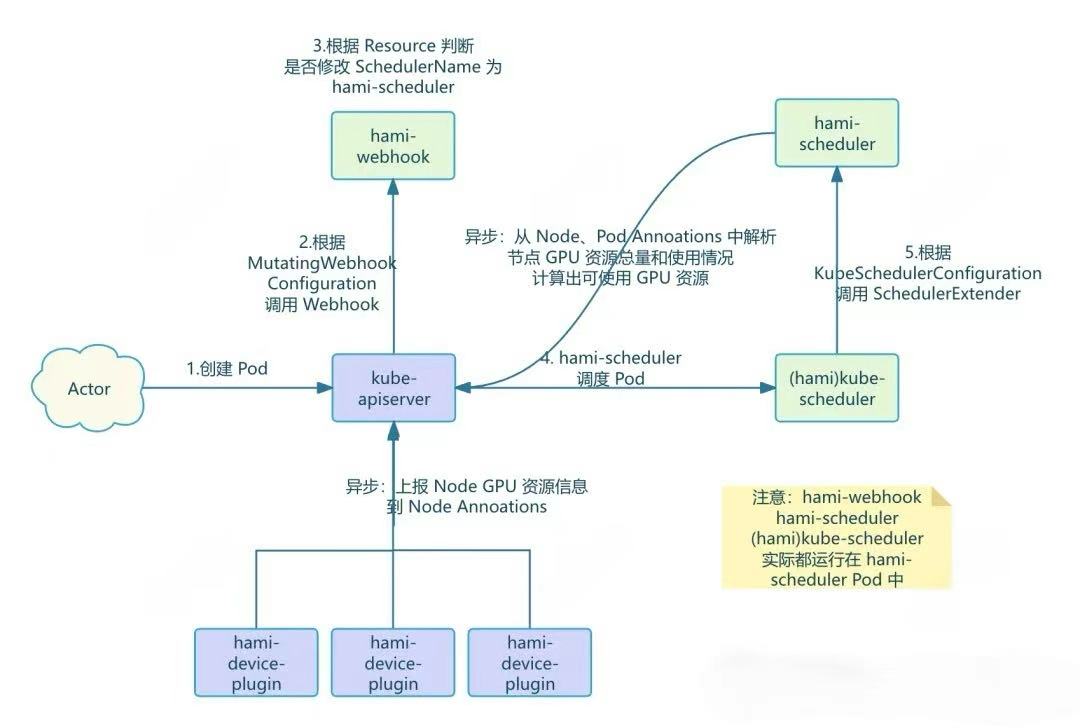
-
用户创建 Pod 并在 Pod 中申请了 vGPU 资源
-
kube-apiserver 根据 MutatingWebhookConfiguration 配置请求 HAMi-Webhook
-
HAMi-Webhook 检测 Pod 中的 Resource,发现是申请的由 HAMi 管理的 vGPU 资源,因此把 Pod 中的 SchedulerName 改成了 hami-scheduler,这样这个 Pod 就会由 hami-scheduler 进行调度了。
-
对于特权模式的 Pod,Webhook 会直接跳过不处理
-
对于使用 vGPU 资源但指定了 nodeName 的 Pod,Webhook 会直接拒绝
- hami-scheduler 进行 Pod 调度,不过就是用的 k8s 的默认 kube-scheduler 镜像,因此调度逻辑和默认的 default-scheduler 是一样的,kube-scheduler 根据 KubeSchedulerConfiguration 配置,调用 Extender Scheduler 插件
-
这个 Extender Scheduler 就是 hami-scheduler Pod 中的另一个 Container,该 Container 同时提供了 Webhook 和 Scheduler 相关 API。
-
当 Pod 申请了 vGPU 资源时,kube-scheduler 就会根据配置以 HTTP 形式调用 Extender Scheduler 插件,这样就实现了自定义调度逻辑
-
Extender Scheduler 插件包含了真正的 hami 调度逻辑,调度时根据节点剩余资源量进行打分选择节点
-
异步任务,包括 GPU 感知逻辑
-
devicePlugin 中的后台 Goroutine 定时上报 Node 上的 GPU 资源并写入到 Node 的 Annoations
-
Extender Scheduler 插件根据 Node Annoations 解析出 GPU 资源总量、从 Node 上已经运行的 Pod 的 Annoations 中解析出 GPU 使用量,计算出每个 Node 剩余的可用资源保存到内存供调度时使用
配置调度策略
hami-scheduler 提供了两种不同级别的调度策略:
-
点调度策略:作用于调度过程中如何为 Pod 选择节点
-
GPU 调度策略:作用于选择节点后,节点存在多 GPU 时如何为 Pod 选择 GPU
根据部署文档,我们可以在部署时指定调度策略
-
scheduler.defaultSchedulerPolicy.nodeSchedulerPolicy: 字符串类型,预设值为"binpack",表示 GPU 节点调度策略。("binpack"表示尽量将任务分配到同一个 GPU 节点上; "spread"表示尽量将任务分配到不同 GPU 节点上。)
-
scheduler.defaultSchedulerPolicy.gpuSchedulerPolicy: 字符串类型,预设值为"spread", 表示 GPU 调度策略。
("binpack"表示尽量将任务分配到同一个 GPU 上;"spread"表示尽量将任务分配到不同 GPU 上。)
就像这样:
helm install vgpu vgpu-charts/vgpu \
  --set scheduler.defaultSchedulerPolicy.nodeSchedulerPolicy=binpark \
  --set scheduler.defaultSchedulerPolicy.gpuSchedulerPolicy=spread
部署后,这两个配置作用域 hami-scheduler 上具体如下:
apiVersion: apps/v1
kind: Deployment
metadata:
  name: vgpu-hami-scheduler
  namespace: kube-system
spec:
  template:
    spec:
      containers:
      - command:
        - scheduler
        - --resource-name=nvidia.com/gpu
        - --resource-mem=nvidia.com/gpumem
        - --resource-cores=nvidia.com/gpucores
        - --resource-mem-percentage=nvidia.com/gpumem-percentage
        - --resource-priority=nvidia.com/priority
        - --http_bind=0.0.0.0:443
        - --cert_file=/tls/tls.crt
        - --key_file=/tls/tls.key
        - --scheduler-name=hami-scheduler
        - --metrics-bind-address=:9395
        - --default-mem=0
        - --default-gpu=1
        - --default-cores=0
        - --iluvatar-memory=iluvatar.ai/vcuda-memory
        - --iluvatar-cores=iluvatar.ai/vcuda-core
        - --cambricon-mlu-name=cambricon.com/vmlu
        - --cambricon-mlu-memory=cambricon.com/mlu.smlu.vmemory
        - --cambricon-mlu-cores=cambricon.com/mlu.smlu.vcore
        - --ascend-name=huawei.com/Ascend910
        - --ascend-memory=huawei.com/Ascend910-memory
        - --ascend310p-name=huawei.com/Ascend310P
        - --ascend310p-memory=huawei.com/Ascend310P-memory
        - --overwrite-env=false
        - --node-scheduler-policy=binpack
        - --gpu-scheduler-policy=spread
就是这两个参数
- --node-scheduler-policy=binpack
- --gpu-scheduler-policy=spread
2. Node 调度策略原理
这部分比较简单,选择节点的逻辑就在 Filter 接口中。
// pkg/scheduler/scheduler.go#L444
func (s *Scheduler) Filter(args extenderv1.ExtenderArgs) (*extenderv1.ExtenderFilterResult, error) {
    klog.InfoS("begin schedule filter", "pod", args.Pod.Name, "uuid", args.Pod.UID, "namespaces", args.Pod.Namespace)
    nums := k8sutil.Resourcereqs(args.Pod)
    total := 0
    for _, n := range nums {
        for _, k := range n {
            total += int(k.Nums)
        }
    }
    if total == 0 {
        klog.V(1).Infof("pod %v not find resource", args.Pod.Name)
        s.recordScheduleFilterResultEvent(args.Pod, EventReasonFilteringFailed, []string{}, fmt.Errorf("does not request any resource"))
        return &extenderv1.ExtenderFilterResult{
            NodeNames:   args.NodeNames,
            FailedNodes: nil,
            Error:       "",
        }, nil
    }
    annos := args.Pod.Annotations
    s.delPod(args.Pod)
    nodeUsage, failedNodes, err := s.getNodesUsage(args.NodeNames, args.Pod)
    if err != nil {
        s.recordScheduleFilterResultEvent(args.Pod, EventReasonFilteringFailed, []string{}, err)
        return nil, err
    }
    if len(failedNodes) != 0 {
        klog.V(5).InfoS("getNodesUsage failed nodes", "nodes", failedNodes)
    }
    nodeScores, err := s.calcScore(nodeUsage, nums, annos, args.Pod)
    if err != nil {
        err := fmt.Errorf("calcScore failed %v for pod %v", err, args.Pod.Name)
        s.recordScheduleFilterResultEvent(args.Pod, EventReasonFilteringFailed, []string{}, err)
        return nil, err
    }
    if len((*nodeScores).NodeList) == 0 {
        klog.V(4).Infof("All node scores do not meet for pod %v", args.Pod.Name)
        s.recordScheduleFilterResultEvent(args.Pod, EventReasonFilteringFailed, []string{}, fmt.Errorf("no available node, all node scores do not meet"))
        return &extenderv1.ExtenderFilterResult{
            FailedNodes: failedNodes,
        }, nil
    }
    klog.V(4).Infoln("nodeScores_len=", len((*nodeScores).NodeList))
    sort.Sort(nodeScores)
    m := (*nodeScores).NodeList[len((*nodeScores).NodeList)-1]
    klog.Infof("schedule %v/%v to %v %v", args.Pod.Namespace, args.Pod.Name, m.NodeID, m.Devices)
    annotations := make(map[string]string)
    annotations[util.AssignedNodeAnnotations] = m.NodeID
    annotations[util.AssignedTimeAnnotations] = strconv.FormatInt(time.Now().Unix(), 10)

    for _, val := range device.GetDevices() {
        val.PatchAnnotations(&annotations, m.Devices)
    }

    //InRequestDevices := util.EncodePodDevices(util.InRequestDevices, m.devices)
    //supportDevices := util.EncodePodDevices(util.SupportDevices, m.devices)
    //maps.Copy(annotations, InRequestDevices)
    //maps.Copy(annotations, supportDevices)
    s.addPod(args.Pod, m.NodeID, m.Devices)
    err = util.PatchPodAnnotations(args.Pod, annotations)
    if err != nil {
        s.recordScheduleFilterResultEvent(args.Pod, EventReasonFilteringFailed, []string{}, err)
        s.delPod(args.Pod)
        return nil, err
    }
    s.recordScheduleFilterResultEvent(args.Pod, EventReasonFilteringSucceed, []string{m.NodeID}, nil)
    res := extenderv1.ExtenderFilterResult{NodeNames: &[]string{m.NodeID}}
    return &res, nil
}
主要就是下面这几句:
// 计算得分,拿到所有满足条件的节点
nodeScores, err := s.calcScore(nodeUsage, nums, annos, args.Pod)

// 排序
sort.Sort(nodeScores)
// 直接选择最后一个节点
m := (*nodeScores).NodeList[len((*nodeScores).NodeList)-1]

// 返回结果
res := extenderv1.ExtenderFilterResult{NodeNames: &[]string{m.NodeID}}
return &res, nil
可以分为两个部分:
-
为所有节点计算得分
-
根据调度策略选择最合适的节点
计算得分
得分计算逻辑在 calcScore 方法里:
// pkg/scheduler/score.go#L185
func (s *Scheduler) calcScore(nodes *map[string]*NodeUsage, nums util.PodDeviceRequests, annos map[string]string, task *corev1.Pod) (*policy.NodeScoreList, error) {
    userNodePolicy := config.NodeSchedulerPolicy
    if annos != nil {
        if value, ok := annos[policy.NodeSchedulerPolicyAnnotationKey]; ok {
            userNodePolicy = value
        }
    }
    res := policy.NodeScoreList{
        Policy:   userNodePolicy,
        NodeList: make([]*policy.NodeScore, 0),
    }

    for nodeID, node := range *nodes {
        viewStatus(*node)
        score := policy.NodeScore{NodeID: nodeID, Devices: make(util.PodDevices), Score: 0}
        score.ComputeScore(node.Devices)

        ctrfit := false
        for ctrid, n := range nums {
            sums := 0
            for _, k := range n {
                sums += int(k.Nums)
            }

            if sums == 0 {
                for idx := range score.Devices {
                    if len(score.Devices[idx]) <= ctrid {
                        score.Devices[idx] = append(score.Devices[idx], util.ContainerDevices{})
                    }
                    score.Devices[idx][ctrid] = append(score.Devices[idx][ctrid], util.ContainerDevice{})
                }
                continue
            }

            klog.V(5).InfoS("fitInDevices", "pod", klog.KObj(task), "node", nodeID)
            fit, _ := fitInDevices(node, n, annos, task, &score.Devices)
            ctrfit = fit
            if !fit {
                klog.InfoS("calcScore:node not fit pod", "pod", klog.KObj(task), "node", nodeID)
                break
            }
        }

        if ctrfit {
            res.NodeList = append(res.NodeList, &score)
        }
    }
    return &res, nil
}
具体算法在 ComputeScore 中:
// pkg/scheduler/policy/node_policy.go#L53
func (ns *NodeScore) ComputeScore(devices DeviceUsageList) {
    // current user having request resource
    used, usedCore, usedMem := int32(0), int32(0), int32(0)
    for _, device := range devices.DeviceLists {
        used += device.Device.Used
        usedCore += device.Device.Usedcores
        usedMem += device.Device.Usedmem
    }
    klog.V(2).Infof("node %s used %d, usedCore %d, usedMem %d,", ns.NodeID, used, usedCore, usedMem)

    total, totalCore, totalMem := int32(0), int32(0), int32(0)
    for _, deviceLists := range devices.DeviceLists {
        total += deviceLists.Device.Count
        totalCore += deviceLists.Device.Totalcore
        totalMem += deviceLists.Device.Totalmem
    }
    useScore := float32(used) / float32(total)
    coreScore := float32(usedCore) / float32(totalCore)
    memScore := float32(usedMem) / float32(totalMem)
    ns.Score = float32(Weight) * (useScore + coreScore + memScore)
    klog.V(2).Infof("node %s computer score is %f", ns.NodeID, ns.Score)
}
具体打分逻辑则是根据每个节点上的已经使用的 GPU Core、GPU Memory 资源和总的 GPU Core、GPU Memory 的比值,根据权重归一化处理后得到最终的得分。
总的来说就是:节点上 GPU Core 和 GPU Memory 资源剩余越少,得分越高。
乍一看这个逻辑有点反直觉了,不是应该资源越多得分越高吗。
问题不大,等看完后续 根据策略选择节点 章节就清楚了。
过滤节点
打分之后还需要根据 Pod 申请的 GPU 信息,过滤掉不满足条件的节点。
比如:Pod 申请 2 vGPU,Node 上只有一张卡,肯定是不行的。
解析 Pod 申请的 GPU 信息
首先是从 Pod 信息中解析出申请的 GPU 信息:
// pkg/scheduler/scheduler.go#L444
func (s *Scheduler) Filter(args extenderv1.ExtenderArgs) (*extenderv1.ExtenderFilterResult, error) {
    nums := k8sutil.Resourcereqs(args.Pod)
}
Resourcereqs 内容如下:
// pkg/k8sutil/pod.go#L27
func Resourcereqs(pod *corev1.Pod) (counts util.PodDeviceRequests) {
    counts = make(util.PodDeviceRequests, len(pod.Spec.Containers))
    // Count Nvidia GPU
    for i := 0; i < len(pod.Spec.Containers); i++ {
        devices := device.GetDevices()
        counts[i] = make(util.ContainerDeviceRequests)
        for idx, val := range devices {
            request := val.GenerateResourceRequests(&pod.Spec.Containers[i])
            if request.Nums > 0 {
                counts[i][idx] = val.GenerateResourceRequests(&pod.Spec.Containers[i])
            }
        }
    }
    klog.InfoS("collect requestreqs", "counts", counts)
    return counts
}
GenerateResourceRequests 是 Interface,以 NVIDIA 实现为例
// pkg/device/nvidia/device.go#L264
func (dev *NvidiaGPUDevices) GenerateResourceRequests(ctr *corev1.Container) util.ContainerDeviceRequest {
    resourceName := corev1.ResourceName(ResourceName)
    resourceMem := corev1.ResourceName(ResourceMem)
    resourceMemPercentage := corev1.ResourceName(ResourceMemPercentage)
    resourceCores := corev1.ResourceName(ResourceCores)

    v, ok := ctr.Resources.Limits[resourceName]
    if !ok {
        v, ok = ctr.Resources.Requests[resourceName]
    }
    if ok {
        if n, ok := v.AsInt64(); ok {
            memnum := 0
            mem, ok := ctr.Resources.Limits[resourceMem]
            if !ok {
                mem, ok = ctr.Resources.Requests[resourceMem]
            }
            if ok {
                memnums, ok := mem.AsInt64()
                if ok {
                    memnum = int(memnums)
                }
            }

            mempnum := int32(101)
            mem, ok = ctr.Resources.Limits[resourceMemPercentage]
            if !ok {
                mem, ok = ctr.Resources.Requests[resourceMemPercentage]
            }
            if ok {
                mempnums, ok := mem.AsInt64()
                if ok {
                    mempnum = int32(mempnums)
                }
            }

            if mempnum == 101 && memnum == 0 {
                if config.DefaultMem != 0 {
                    memnum = int(config.DefaultMem)
                } else {
                    mempnum = 100
                }
            }

            corenum := config.DefaultCores
            core, ok := ctr.Resources.Limits[resourceCores]
            if !ok {
                core, ok = ctr.Resources.Requests[resourceCores]
            }
            if ok {
                corenums, ok := core.AsInt64()
                if ok {
                    corenum = int32(corenums)
                }
            }

            return util.ContainerDeviceRequest{
                Nums:             int32(n),
                Type:             NvidiaGPUDevice,
                Memreq:           int32(memnum),
                MemPercentagereq: int32(mempnum),
                Coresreq:         int32(corenum),
            }
        }
    }
    return util.ContainerDeviceRequest{}
}
逻辑也比较简单,就是从 Container 的 Resources 中根据名称解析拿到申请的 gpu、gpucore、gpumem 等信息。
过滤节点
逻辑同样在 calcScore 方法中,具体如下:
ctrfit := false
for ctrid, n := range nums {
    sums := 0
    for _, k := range n {
        sums += int(k.Nums)
    }

    if sums == 0 {
        for idx := range score.Devices {
            if len(score.Devices[idx]) <= ctrid {
                score.Devices[idx] = append(score.Devices[idx], util.ContainerDevices{})
            }
            score.Devices[idx][ctrid] = append(score.Devices[idx][ctrid], util.ContainerDevice{})
        }
        continue
    }

    klog.V(5).InfoS("fitInDevices", "pod", klog.KObj(task), "node", nodeID)
    fit, _ := fitInDevices(node, n, annos, task, &score.Devices)
    ctrfit = fit
    if !fit {
        klog.InfoS("calcScore:node not fit pod", "pod", klog.KObj(task), "node", nodeID)
        break
    }
}

if ctrfit {
    res.NodeList = append(res.NodeList, &score)
}
-
nums 就是上一步解析出来的 Pod 的 GPU 申请情况
-
score.Devices:就是当前节点上的 GPU 设备
具体过滤规则在这里:
fit, _ := fitInDevices(node, n, annos, task, &score.Devices)
fitInDevices 内容如下:
内容比较多,去掉了其他无关内容,主要就是做了这几个判断,如果都满足则记录对应的 GPU 信息并返回 true,否则返回 false,表示该节点无法调度。
func fitInCertainDevice(node *NodeUsage, request util.ContainerDeviceRequest, annos map[string]string, pod *corev1.Pod) (bool, map[string]util.ContainerDevices) {
    // ....
    for i := len(node.Devices.DeviceLists) - 1; i >= 0; i-- {
        if node.Devices.DeviceLists[i].Device.Totalmem-node.Devices.DeviceLists[i].Device.Usedmem < memreq {
            continue
        }
        if node.Devices.DeviceLists[i].Device.Totalcore-node.Devices.DeviceLists[i].Device.Usedcores < k.Coresreq {
            continue
        }
        // Coresreq=100 indicates it want this card exclusively
        if node.Devices.DeviceLists[i].Device.Totalcore == 100 && k.Coresreq == 100 && node.Devices.DeviceLists[i].Device.Used > 0 {
            continue
        }
        // You can't allocate core=0 job to an already full GPU
        if node.Devices.DeviceLists[i].Device.Totalcore != 0 && node.Devices.DeviceLists[i].Device.Usedcores == node.Devices.DeviceLists[i].Device.Totalcore && k.Coresreq == 0 {
            continue
        }
        if k.Nums > 0 {
            klog.InfoS("first fitted", "pod", klog.KObj(pod), "device", node.Devices.DeviceLists[i].Device.ID)
            k.Nums--
            tmpDevs[k.Type] = append(tmpDevs[k.Type], util.ContainerDevice{
                Idx:       int(node.Devices.DeviceLists[i].Device.Index),
                UUID:      node.Devices.DeviceLists[i].Device.ID,
                Type:      k.Type,
                Usedmem:   memreq,
                Usedcores: k.Coresreq,
            })
        }
        if k.Nums == 0 {
            klog.InfoS("device allocate success", "pod", klog.KObj(pod), "allocate device", tmpDevs)
            return true, tmpDevs
        }
    }
    return false, tmpDevs
}
这样,我们就把不满足条件的节点给过滤掉了,剩下的节点都是可以正常调度 Pod 的,不过具体选择哪个节点还需要依赖于配置的调度策略。
根据策略选择节点
上一步计算出了每个节点的得分之后,就可以根据策略进行选择了。
// 计算得分,拿到所有满足条件的节点
nodeScores, err := s.calcScore(nodeUsage, nums, annos, args.Pod)

// 排序
sort.Sort(nodeScores)
// 直接选择最后一个节点
m := (*nodeScores).NodeList[len((*nodeScores).NodeList)-1]

// 返回结果
res := extenderv1.ExtenderFilterResult{NodeNames: &[]string{m.NodeID}}
return &res, nil
具体的选择逻辑在这里:
// 排序
sort.Sort(nodeScores)
// 直接选择最后一个节点
m := (*nodeScores).NodeList[len((*nodeScores).NodeList)-1]
对得分数据排序后,直接就选择了最后一个节点。
初次看到这里时也有点懵,想不明白这怎么和调度策略牵扯到一起的。
实际上具体逻辑就在 sort 这里,NodeScoreList 要实现 sort 接口才能进行排序,因此看下是怎么实现的:
// pkg/scheduler/policy/node_policy.go#L32
type NodeScoreList struct {
    NodeList []*NodeScore
    Policy   string
}

func (l NodeScoreList) Len() int {
    return len(l.NodeList)
}

func (l NodeScoreList) Swap(i, j int) {
    l.NodeList[i], l.NodeList[j] = l.NodeList[j], l.NodeList[i]
}

func (l NodeScoreList) Less(i, j int) bool {
    if l.Policy == NodeSchedulerPolicySpread.String() {
        return l.NodeList[i].Score > l.NodeList[j].Score
    }
    // default policy is Binpack
    return l.NodeList[i].Score < l.NodeList[j].Score
}
核心部分:
func (l NodeScoreList) Less(i, j int) bool {
    if l.Policy == NodeSchedulerPolicySpread.String() {
        return l.NodeList[i].Score > l.NodeList[j].Score
    }
    // default policy is Binpack
    return l.NodeList[i].Score < l.NodeList[j].Score
}
根据我们的 Policy 不同,有两种排序方式,而且排序正好相反。
// NodeSchedulerPolicyBinpack is node use binpack scheduler policy.
NodeSchedulerPolicyBinpack SchedulerPolicyName = "binpack"
// NodeSchedulerPolicySpread is node use spread scheduler policy.
NodeSchedulerPolicySpread SchedulerPolicyName = "spread"
这里涉及到 sort.Sort() 的实现,简单来说:
-
如果 Less() 方法中使用大于(>)比较,最终排序结果将是降序。
-
如果 Less() 方法中使用小于(<)比较,最终排序结果将是升序。
对应到调度策略:
-
Binpack 策略使用 小于(<)比较,最终排序结果将是升序
-
Spread 策略使用 大于(>)比较,最终排序结果将是降序
又因为前面打分时的规则是:剩余资源越少,得分越低,再加上我们会选择排序后的最后一个节点。
至此,逻辑就清晰了。
-
Binpack 策略选择最后一个节点,因为升序排列,最后一个 Node 得分最高,即:空闲资源最少
-
Spread 策略选择最后一个节点,因为降序排列,最后一个 Node 得分最低,即:空闲资源最多
正好符合了策略的原本含义:
-
Binpack 则是让所有 Pod 尽量调度到同一个节点,优先把一个节点资源用完,然后再使用其他节点。
-
Spread 则是相反,尽量让 Pod 分散到所有节点上去。
调度策略是哪儿来的
这部分逻辑实际上是在 calScore 方法里:
func (s *Scheduler) calcScore(nodes *map[string]*NodeUsage, nums util.PodDeviceRequests, annos map[string]string, task *corev1.Pod) (*policy.NodeScoreList, error) {
    userNodePolicy := config.NodeSchedulerPolicy
    if annos != nil {
        if value, ok := annos[policy.NodeSchedulerPolicyAnnotationKey]; ok {
            userNodePolicy = value
        }
    }
    res := policy.NodeScoreList{
        Policy:   userNodePolicy,
        NodeList: make([]*policy.NodeScore, 0),
    }
}
首先使用默认的调度策略,当然默认调度策略也是会被参数覆盖的:
rootCmd.Flags().StringVar(&config.NodeSchedulerPolicy, "node-scheduler-policy", policy.NodeSchedulerPolicyBinpack.String(), "node scheduler policy")
rootCmd.Flags().StringVar(&config.GPUSchedulerPolicy, "gpu-scheduler-policy", policy.GPUSchedulerPolicySpread.String(), "GPU scheduler policy")
然后解析 Pod 的 Annoations,如果有指定 hami.io/node-scheduler-policy 就使用 Pod 上指定的调度策略。
至此,Node 调度策略就分析完成了。
3.GPU 调度策略原理
当 Node 选好之后,Node 上有多块 GPU,Pod 还分配哪块呢?这时候就该 GPU 调度策略生效了。
实际上选择 GPU 的逻辑也暗含在 Filter 方法里了。
// pkg/scheduler/scheduler.go#L444
func (s *Scheduler) Filter(args extenderv1.ExtenderArgs) (*extenderv1.ExtenderFilterResult, error) {
    klog.InfoS("begin schedule filter", "pod", args.Pod.Name, "uuid", args.Pod.UID, "namespaces", args.Pod.Namespace)
    nums := k8sutil.Resourcereqs(args.Pod)
    total := 0
    for _, n := range nums {
        for _, k := range n {
            total += int(k.Nums)
        }
    }
    if total == 0 {
        klog.V(1).Infof("pod %v not find resource", args.Pod.Name)
        s.recordScheduleFilterResultEvent(args.Pod, EventReasonFilteringFailed, []string{}, fmt.Errorf("does not request any resource"))
        return &extenderv1.ExtenderFilterResult{
            NodeNames:   args.NodeNames,
            FailedNodes: nil,
            Error:       "",
        }, nil
    }
    annos := args.Pod.Annotations
    s.delPod(args.Pod)
    nodeUsage, failedNodes, err := s.getNodesUsage(args.NodeNames, args.Pod)
    if err != nil {
        s.recordScheduleFilterResultEvent(args.Pod, EventReasonFilteringFailed, []string{}, err)
        return nil, err
    }
    if len(failedNodes) != 0 {
        klog.V(5).InfoS("getNodesUsage failed nodes", "nodes", failedNodes)
    }
    nodeScores, err := s.calcScore(nodeUsage, nums, annos, args.Pod)
    if err != nil {
        err := fmt.Errorf("calcScore failed %v for pod %v", err, args.Pod.Name)
        s.recordScheduleFilterResultEvent(args.Pod, EventReasonFilteringFailed, []string{}, err)
        return nil, err
    }
    if len((*nodeScores).NodeList) == 0 {
        klog.V(4).Infof("All node scores do not meet for pod %v", args.Pod.Name)
        s.recordScheduleFilterResultEvent(args.Pod, EventReasonFilteringFailed, []string{}, fmt.Errorf("no available node, all node scores do not meet"))
        return &extenderv1.ExtenderFilterResult{
            FailedNodes: failedNodes,
        }, nil
    }
    klog.V(4).Infoln("nodeScores_len=", len((*nodeScores).NodeList))
    sort.Sort(nodeScores)
    m := (*nodeScores).NodeList[len((*nodeScores).NodeList)-1]
    klog.Infof("schedule %v/%v to %v %v", args.Pod.Namespace, args.Pod.Name, m.NodeID, m.Devices)
    annotations := make(map[string]string)
    annotations[util.AssignedNodeAnnotations] = m.NodeID
    annotations[util.AssignedTimeAnnotations] = strconv.FormatInt(time.Now().Unix(), 10)

    for _, val := range device.GetDevices() {
        val.PatchAnnotations(&annotations, m.Devices)
    }

    //InRequestDevices := util.EncodePodDevices(util.InRequestDevices, m.devices)
    //supportDevices := util.EncodePodDevices(util.SupportDevices, m.devices)
    //maps.Copy(annotations, InRequestDevices)
    //maps.Copy(annotations, supportDevices)
    s.addPod(args.Pod, m.NodeID, m.Devices)
    err = util.PatchPodAnnotations(args.Pod, annotations)
    if err != nil {
        s.recordScheduleFilterResultEvent(args.Pod, EventReasonFilteringFailed, []string{}, err)
        s.delPod(args.Pod)
        return nil, err
    }
    s.recordScheduleFilterResultEvent(args.Pod, EventReasonFilteringSucceed, []string{m.NodeID}, nil)
    res := extenderv1.ExtenderFilterResult{NodeNames: &[]string{m.NodeID}}
    return &res, nil
}
过滤 GPU
解析 Pod 申请的 GPU 信息
首先是从 Pod 信息中解析出申请的 GPU 信息:
// pkg/scheduler/scheduler.go#L444
func (s *Scheduler) Filter(args extenderv1.ExtenderArgs) (*extenderv1.ExtenderFilterResult, error) {
    nums := k8sutil.Resourcereqs(args.Pod)
}
和 Node 调度策略中的一样,这里就不在赘述了。
过滤 GPU
这部分逻辑隐藏比较深刻,在 fitInDevices 方法中
// pkg/scheduler/score.go#L185
func (s *Scheduler) calcScore(nodes *map[string]*NodeUsage, nums util.PodDeviceRequests, annos map[string]string, task *corev1.Pod) (*policy.NodeScoreList, error) {
    for nodeID, node := range *nodes {
        fit, _ := fitInDevices(node, n, annos, task, &score.Devices)
    }
}
fitInDevices 内容如下:
func fitInDevices(node *NodeUsage, requests util.ContainerDeviceRequests, annos map[string]string, pod *corev1.Pod, devinput *util.PodDevices) (bool, float32) {
    devs := util.ContainerDevices{}
    total, totalCore, totalMem := int32(0), int32(0), int32(0)
    free, freeCore, freeMem := int32(0), int32(0), int32(0)
    sums := 0

    // computer all device score for one node
    for index := range node.Devices.DeviceLists {
        node.Devices.DeviceLists[index].ComputeScore(requests)
    }

    // This loop is for requests for different devices
    for _, k := range requests {
        sums += int(k.Nums)
        if int(k.Nums) > len(node.Devices.DeviceLists) {
            klog.InfoS("request devices nums cannot exceed the total number of devices on the node.",
                "pod", klog.KObj(pod),
                "request devices nums", k.Nums,
                "node device nums", len(node.Devices.DeviceLists))
            return false, 0
        }

        sort.Sort(node.Devices)
        fit, tmpDevs := fitInCertainDevice(node, k, annos, pod)
        if fit {
            for _, val := range tmpDevs[k.Type] {
                total += node.Devices.DeviceLists[val.Idx].Device.Count
                totalCore += node.Devices.DeviceLists[val.Idx].Device.Totalcore
                totalMem += node.Devices.DeviceLists[val.Idx].Device.Totalmem

                free += node.Devices.DeviceLists[val.Idx].Device.Count - node.Devices.DeviceLists[val.Idx].Device.Used
                freeCore += node.Devices.DeviceLists[val.Idx].Device.Totalcore - node.Devices.DeviceLists[val.Idx].Device.Usedcores
                freeMem += node.Devices.DeviceLists[val.Idx].Device.Totalmem - node.Devices.DeviceLists[val.Idx].Device.Usedmem

                node.Devices.DeviceLists[val.Idx].Device.Used++
                node.Devices.DeviceLists[val.Idx].Device.Usedcores += val.Usedcores
                node.Devices.DeviceLists[val.Idx].Device.Usedmem += val.Usedmem
            }
            devs = append(devs, tmpDevs[k.Type]...)
        } else {
            return false, 0
        }
        (*devinput)[k.Type] = append((*devinput)[k.Type], devs)
    }
    return true, 0
}
核心部分:
for _, k := range requests {
    sort.Sort(node.Devices)
    fit, tmpDevs := fitInCertainDevice(node, k, annos, pod)
    if fit {
        devs = append(devs, tmpDevs[k.Type]...)
    } else {
        return false, 0
    }
    (*devinput)[k.Type] = append((*devinput)[k.Type], devs)
}
这里又出现了 sort.Sort 是不是有点熟悉,不过暂时先不管,还是先分析怎么过滤 GPU 的。
核心部分在 fitInCertainDevice 中,根据 Pod 申请的 GPU 信息找出当前节点上所有满足条件的 GPU
fit, tmpDevs := fitInCertainDevice(node, k, annos, pod)
fitInCertainDevice 在前面过滤 Node 时也分析过,这里就简单看下
func fitInCertainDevice(node *NodeUsage, request util.ContainerDeviceRequest, annos map[string]string, pod *corev1.Pod) (bool, map[string]util.ContainerDevices) {
    tmpDevs := make(map[string]util.ContainerDevices)
    k := request
    memreq := k.Memreq
    if k.MemPercentagereq != 101 {
        memreq = int32(float64(k.MemPercentagereq) * 0.01 * float64(node.Devices.DeviceLists[0].Device.Totalmem))
    }

    for i := len(node.Devices.DeviceLists) - 1; i >= 0; i-- {
        if node.Devices.DeviceLists[i].Device.Totalmem-node.Devices.DeviceLists[i].Device.Usedmem < memreq {
            continue
        }
        if node.Devices.DeviceLists[i].Device.Totalcore-node.Devices.DeviceLists[i].Device.Usedcores < k.Coresreq {
            continue
        }
        // Coresreq=100 indicates it want this card exclusively
        if node.Devices.DeviceLists[i].Device.Totalcore == 100 && k.Coresreq == 100 && node.Devices.DeviceLists[i].Device.Used > 0 {
            continue
        }
        // You can't allocate core=0 job to an already full GPU
        if node.Devices.DeviceLists[i].Device.Totalcore != 0 && node.Devices.DeviceLists[i].Device.Usedcores == node.Devices.DeviceLists[i].Device.Totalcore && k.Coresreq == 0 {
            continue
        }
        if k.Nums > 0 {
            k.Nums--
            tmpDevs[k.Type] = append(tmpDevs[k.Type], util.ContainerDevice{
                Idx:       int(node.Devices.DeviceLists[i].Device.Index),
                UUID:      node.Devices.DeviceLists[i].Device.ID,
                Type:      k.Type,
                Usedmem:   memreq,
                Usedcores: k.Coresreq,
            })
        }
        if k.Nums == 0 {
            klog.InfoS("device allocate success", "pod", klog.KObj(pod), "allocate device", tmpDevs)
            return true, tmpDevs
        }
    }
    return false, tmpDevs
}
如果某个 GPU 能满足这些条件就认为该 GPU 可以分配给对应 Container。
又回到前面的核心逻辑,对于满足条件的 GPU,这里使用了 devinput 对象进行记录。
for _, k := range requests {
    sort.Sort(node.Devices)
    fit, tmpDevs := fitInCertainDevice(node, k, annos, pod)
    if fit {
        devs = append(devs, tmpDevs[k.Type]...)
    } else {
        return false, 0
    }
    (*devinput)[k.Type] = append((*devinput)[k.Type], devs)
}
这里的 devinput 实际上就是前面传进来的 Score 对象。
type NodeScore struct {
    NodeID  string
    Devices util.PodDevices
    // Score recode every node all device user/allocate score
    Score float32
}
标记到 Pod 上
hami 为了让后续的 DevicePlugin 能够知道要把哪些 GPU 分配给该 Pod,是直接将其记录到 Pod 的 Annoations 上的。
// pkg/scheduler/scheduler.go
func (s *Scheduler) Filter(args extenderv1.ExtenderArgs) (*extenderv1.ExtenderFilterResult, error) {
    // ... 前置逻辑省略 ...
    sort.Sort(nodeScores)
    m := (*nodeScores).NodeList[len((*nodeScores).NodeList)-1]
    klog.Infof("schedule %v/%v to %v %v", args.Pod.Namespace, args.Pod.Name, m.NodeID, m.Devices)
    annotations := make(map[string]string)
    annotations[util.AssignedNodeAnnotations] = m.NodeID
    annotations[util.AssignedTimeAnnotations] = strconv.FormatInt(time.Now().Unix(), 10)

    for _, val := range device.GetDevices() {
        val.PatchAnnotations(&annotations, m.Devices)
    }
}
选择到节点之后,还把 m.Devices 信息记录到了 Pod 的 Annoations 上。
annotations := make(map[string]string)
annotations[util.AssignedNodeAnnotations] = m.NodeID
annotations[util.AssignedTimeAnnotations] = strconv.FormatInt(time.Now().Unix(), 10)

for _, val := range device.GetDevices() {
    val.PatchAnnotations(&annotations, m.Devices)
}
这里的 m.Devices 实际上就是前面我们过滤出来的满足条件的 GPU。
Annoations 大概是这样的:
apiVersion: v1
kind: Pod
metadata:
  annotations:
    hami.io/bind-phase: allocating
    hami.io/bind-time: "1732072495"
    hami.io/vgpu-devices-allocated: GPU-1afede84-4e70-2174-49af-f07ebb94d1ae,NVIDIA,20000,30:;
    hami.io/vgpu-devices-to-allocate: GPU-1afede84-4e70-2174-49af-f07ebb94d1ae,NVIDIA,20000,30:;
    hami.io/vgpu-node: test
    hami.io/vgpu-time: "1732072495"
-
hami.io/vgpu-devices-to-allocate 是 Scheduler 为 Pod 选择的目标 GPU
-
hami.io/vgpu-devices-allocated 是当前已经分配的
ps:对于已经调度的 Pod hami.io/vgpu-devices-to-allocate 会被清空
调度完成后,DevicePlugin 直接读取 hami.io/vgpu-devices-to-allocate 就知道要为该 Pod 分配哪些 GPU 了。
根据策略选择 GPU
前面都已经选出了满足条件的 GPU 甚至都记录到了 Pod 的 Annoations 上了,那么 GPU 调度策略是什么时候生效的呢?
GPU 打分
逻辑和 Node 打分逻辑基本一致:都是剩余资源越多,得分越低。
func (ds *DeviceListsScore) ComputeScore(requests util.ContainerDeviceRequests) {
    request, core, mem := int32(0), int32(0), int32(0)
    // 仅针对同一类型设备计算
    for _, container := range requests {
        request += container.Nums
        core += container.Coresreq
        if container.MemPercentagereq != 0 && container.MemPercentagereq != 101 {
            mem += int32(float32(ds.Device.Totalmem) * (float32(container.MemPercentagereq) / 100.0))
            continue
        }
        mem += container.Memreq
    }
    klog.V(2).InfoS("device resource usage",
        "deviceID", ds.Device.ID,
        "used", ds.Device.Used,
        "usedCore", ds.Device.Usedcores,
        "usedMem", ds.Device.Usedmem)

    usedScore := float32(request+ds.Device.Used) / float32(ds.Device.Count)
    coreScore := float32(core+ds.Device.Usedcores) / float32(ds.Device.Totalcore)
    memScore  := float32(mem+ds.Device.Usedmem) / float32(ds.Device.Totalmem)
    ds.Score  = float32(Weight) * (usedScore + coreScore + memScore)
    klog.V(2).InfoS("device score calculated",
        "deviceID", ds.Device.ID,
        "score", ds.Score)
}
排序
这部分也在 fitInDevices 方法中
// pkg/scheduler/score.go#L144
func fitInDevices(node *NodeUsage, requests util.ContainerDeviceRequests, annos map[string]string, pod *corev1.Pod, devinput *util.PodDevices) (bool, float32) {
    for _, k := range requests {
        sort.Sort(node.Devices)
        fit, tmpDevs := fitInCertainDevice(node, k, annos, pod)
        if fit {
            devs = append(devs, tmpDevs[k.Type]...)
        } else {
            return false, 0
        }
        (*devinput)[k.Type] = append((*devinput)[k.Type], devs)
    }
}
核心就是这个 sort 方法
sort.Sort(node.Devices)
又出现了 sort.Sort 是不是想到了什么。
前面选择节点的时候也是这样实现的,把具体逻辑放在 sort 接口实现上。看看 GPU 的 Sort 接口怎么实现的:
func (l DeviceUsageList) Len() int {
    return len(l.DeviceLists)
}

func (l DeviceUsageList) Swap(i, j int) {
    l.DeviceLists[i], l.DeviceLists[j] = l.DeviceLists[j], l.DeviceLists[i]
}

func (l DeviceUsageList) Less(i, j int) bool {
    if l.Policy == GPUSchedulerPolicyBinpack.String() {
        if l.DeviceLists[i].Device.Numa == l.DeviceLists[j].Device.Numa {
            return l.DeviceLists[i].Score < l.DeviceLists[j].Score
        }
        return l.DeviceLists[i].Device.Numa > l.DeviceLists[j].Device.Numa
    }
    // default policy is spread
    if l.DeviceLists[i].Device.Numa == l.DeviceLists[j].Device.Numa {
        return l.DeviceLists[i].Score > l.DeviceLists[j].Score
    }
    return l.DeviceLists[i].Device.Numa < l.DeviceLists[j].Device.Numa
}
果然又是这样的,根据不同的 GPU 调度策略,Less 方法返回不同结果以控制排序结果是降序还是升序。
选择 GPU
然后后续再选择 GPU 的时候的代码如下:
func fitInCertainDevice(node *NodeUsage, request util.ContainerDeviceRequest, annos map[string]string, pod *corev1.Pod) (bool, map[string]util.ContainerDevices) {
    tmpDevs := make(map[string]util.ContainerDevices)
    k := request
    memreq := k.Memreq
    if k.MemPercentagereq != 101 {
        memreq = int32(float64(k.MemPercentagereq) * 0.01 * float64(node.Devices.DeviceLists[0].Device.Totalmem))
    }

    for i := len(node.Devices.DeviceLists) - 1; i >= 0; i-- {
        if node.Devices.DeviceLists[i].Device.Totalmem-node.Devices.DeviceLists[i].Device.Usedmem < memreq {
            continue
        }
        if node.Devices.DeviceLists[i].Device.Totalcore-node.Devices.DeviceLists[i].Device.Usedcores < k.Coresreq {
            continue
        }
        // Coresreq=100 indicates it want this card exclusively
        if node.Devices.DeviceLists[i].Device.Totalcore == 100 && k.Coresreq == 100 && node.Devices.DeviceLists[i].Device.Used > 0 {
            continue
        }
        // You can't allocate core=0 job to an already full GPU
        if node.Devices.DeviceLists[i].Device.Totalcore != 0 && node.Devices.DeviceLists[i].Device.Usedcores == node.Devices.DeviceLists[i].Device.Totalcore && k.Coresreq == 0 {
            continue
        }
        if k.Nums > 0 {
            k.Nums--
            tmpDevs[k.Type] = append(tmpDevs[k.Type], util.ContainerDevice{
                Idx:       int(node.Devices.DeviceLists[i].Device.Index),
                UUID:      node.Devices.DeviceLists[i].Device.ID,
                Type:      k.Type,
                Usedmem:   memreq,
                Usedcores: k.Coresreq,
            })
        }
        if k.Nums == 0 {
            klog.InfoS("device allocate success", "pod", klog.KObj(pod), "allocate device", tmpDevs)
            return true, tmpDevs
        }
    }
    return false, tmpDevs
}
核心是这个 for 循环
for i := len(node.Devices.DeviceLists) - 1; i >= 0; i-- {
}
也是从最后一个 GPU 开始的,也就是如果排在后面的 GPU 满足条件就会直接被选中,不会再去选择前面的了。
-
Binpack 策略:结果为升序,越往后的 GPU 空闲资源越少
-
Spread 策略:结果为降序,越往后的 GPU 空闲资源越多
同样也是符合对应策略含义的。
至此,GPU 调度策略也分析完了。
DevicePlugin 解析 GPU 信息
在调度时,我们把最终选择的 GPU 记录到了 Pod 的 Annoations 上,DevicePlugin 这边就不需要选择 GPU 了,从 Annoations 上解析即可
// pkg/util/util.go#L281
func GetNextDeviceRequest(dtype string, p corev1.Pod) (corev1.Container, ContainerDevices, error) {
    pdevices, err := DecodePodDevices(InRequestDevices, p.Annotations)
    if err != nil {
        return corev1.Container{}, ContainerDevices{}, err
    }
    klog.Infof("pod annotation decode value is %+v", pdevices)
    res := ContainerDevices{}

    pd, ok := pdevices[dtype]
    if !ok {
        return corev1.Container{}, res, errors.New("device request not found")
    }
    for ctridx, ctrDevice := range pd {
        if len(ctrDevice) > 0 {
            return p.Spec.Containers[ctridx], ctrDevice, nil
        }
    }
    return corev1.Container{}, res, errors.New("device request not found")
}

// pkg/util/util.go#L254
func DecodePodDevices(checklist map[string]string, annos map[string]string) (PodDevices, error) {
    klog.V(5).Infof("checklist is [%+v], annos is [%+v]", checklist, annos)
    if len(annos) == 0 {
        return PodDevices{}, nil
    }
    pd := make(PodDevices)
    for devID, devs := range checklist {
        str, ok := annos[devs]
        if !ok {
            continue
        }
        pd[devID] = make(PodSingleDevice, 0)
        for _, s := range strings.Split(str, OnePodMultiContainerSplitSymbol) {
            cd, err := DecodeContainerDevices(s)
            if err != nil {
                return PodDevices{}, nil
            }
            if len(cd) == 0 {
                continue
            }
            pd[devID] = append(pd[devID], cd)
        }
    }
    klog.InfoS("Decoded pod annos", "poddevices", pd)
    return pd, nil
}
具体的解析逻辑如下,就是按照预设规则,以冒号,逗号进行切分
// pkg/util/util.go#L223
func DecodeContainerDevices(str string) (ContainerDevices, error) {
    if len(str) == 0 {
        return ContainerDevices{}, nil
    }
    cd := strings.Split(str, OneContainerMultiDeviceSplitSymbol)
    contdev := ContainerDevices{}
    tmpdev := ContainerDevice{}
    klog.V(5).InfoS("Start to decode container device", "str", str)
    if len(str) == 0 {
        return ContainerDevices{}, nil
    }
    for _, val := range cd {
        if strings.Contains(val, ",") {
            tmpstr := strings.Split(val, ",")
            if len(tmpstr) < 4 {
                return ContainerDevices{}, fmt.Errorf("pod annotation format error; information missing, please do not use nodeName field in task")
            }
            tmpdev.UUID = tmpstr[0]
            tmpdev.Type = tmpstr[1]
            devmem, _ := strconv.ParseInt(tmpstr[2], 10, 32)
            tmpdev.Usedmem = int32(devmem)
            devcores, _ := strconv.ParseInt(tmpstr[3], 10, 32)
            tmpdev.Usedcores = int32(devcores)
            contdev = append(contdev, tmpdev)
        }
    }
    klog.V(5).InfoS("Finished decoding container devices", "totalDevices", len(contdev))
    return contdev, nil
}
至此,hami 提供的 Node、GPU 级别的 Spread、Binpack 高级调度策略就分析完成了。
4.小结
调度策略配置
hami-scheduler 提供了两种不同级别的调度策略:
-
节点调度策略:作用于调度过程中如何为 Pod 选择节点
-
GPU 调度策略:作用于选择节点后,节点存在多 GPU 时如何为 Pod 选择 GPU
二者都支持 Spread 和 Binpack 两种配置:
-
Spread 表示尽量将任务分配到不同 Node 或 GPU 上,让集群中的 Node 或 GPU 负载尽量保持相同水位线。
-
Binpack 表示尽量将任务分配到同一 Node 或者 GPU 上,尽量先占满一个 Node 或者 GPU 后再使用别的
具体 Node、GPU 调度策略实现都可以分为以下几步
-
给 Node、GPU 打分
-
过滤掉不满足条件的 Node、GPU
-
根据调度策略选择出最优 Node、GPU
-
具体逻辑都在 sort.Sort 接口的 Less 方法实现的
-
对于 Spread 策略就选择剩余资源多的 Node、GPU,Binpack 策略就选择剩余资源少的 Node、GPU
- 对结果进行记录 Node
-
则是通过 Bind 结果直接和 Pod 绑定
-
GPU 则是记录到 Pod 的 Annoations 上