精准而优雅:HAMi 调度特性之按 GPU 类型和 UUID 调度
本文摘自:https://mp.weixin.qq.com/s/1eQC2_WGhN7DMNnTW4r0cw
上一篇我们简单分析一下 HAMi-Core(libvgpu.so) vCUDA 的工作原理,包括怎么生效的,CUDA API 怎么拦截的,以及是怎么实现的对 GPU 的 core、memory 资源的 limit 的。
这一篇我们分析一下 HAMi 的调度特性:根据 GPU 类型甚至 UUID 实现精细调度。
1.概述
HAMi 提供了按 GPU 类型和 GPU UUID 的精准调度的能力:
-
By Type:通过指定 GPU 型号(如 A100、A40)来调度 Pod,让任务仅调度 (或者不调度) 到某些指定类型的卡上
-
By UUID:通过指定特定 GPU 的 UUID 来调度任务,让任务仅调度 (或者不调度) 到调度到特定 UUID 对应的卡上
这两个特性使得用户能够灵活地控制 Pod 的调度,确保任务在特定 GPU 上运行,从而优化资源利用或满足特定硬件要求。
对于 NVIDIA GPU 来说,不论什么型号都是统一使用 nvidia.com/gpu 作为 ResourceName,即使是固定申请 10% core,对于不同 GPU 来说肯定性能也是不同的,因此可以使用该特性将性能需求较大的任务调度到高性能 GPU 上。
具体 Workflow 可以分为以下几个步骤:
-
Device-Plugin 上报 GPU 信息:GPU 的类型和 UUID 通过 device-plugin 进行上报,并注册到 Node 的 Annotations 中。
-
Pod 创建时指定 Annotations:Pod 的 Annotations 中指定要调度的 GPU 类型或 UUID。
-
HAMi Scheduler 调度:hami-scheduler 根据 Pod 的 Annotations 和节点上注册的 GPU 信息,过滤掉不满足条件的节点和 GPU,并最终选择合适的节点和 GPU。
-
GPU 分配:当设备插件为 Pod 分配 GPU 时,它从 Annotations 中获取 GPU 信息,并进行分配。
以下分析基于 v2.4 版本
2. DevicePlugin 上报 GPU 信息
这部分之前详细分析过,推荐阅读:HAMi vGPU 方案原理分析 Part1:hami-device-plugin-nvidia 实现
上报 GPU 信息
对于 K8s 提供的标准 DevicePlugin 来说,只能上报每个节点上有多少标准资源,通过 ResourceName 区分,例如:nvidia.com/vgpu。
其中并不包括我们调度所需要的 GPU 信息,例如:Type、UUID、显存 等信息,因此新增了部分自定义逻辑,如下:
// pkg/device-plugin/nvidiadevice/nvinternal/plugin/register.go#L199
func (plugin *NvidiaDevicePlugin) WatchAndRegister() {
    klog.Info("Starting WatchAndRegister")
    errorSleepInterval := time.Second * 5
    successSleepInterval := time.Second * 30
    for {
       err := plugin.RegistrInAnnotation()
       if err != nil {
          klog.Errorf("Failed to register annotation: %v", err)
          klog.Infof("Retrying in %v seconds...", errorSleepInterval)
          time.Sleep(errorSleepInterval)
       } else {
          klog.Infof("Successfully registered annotation. Next check in %v seconds...", successSleepInterval)
          time.Sleep(successSleepInterval)
       }
    }
}
启动这个 WatchAndRegister 的后台 Goroutine 感知 Node 上的 GPU 信息然后以 Annoations 形式更新到 Node 对象上,以实现 GPU 信息注册。
GPU 信息格式如下:
// pkg/device-plugin/nvidiadevice/nvinternal/plugin/register.go#L155
res = append(res, &api.DeviceInfo{
    ID:      UUID,
    Count:   int32(*util.DeviceSplitCount),
    Devmem:  registeredmem,
    Devcore: int32(*util.DeviceCoresScaling * 100),
    Type:    fmt.Sprintf("%v-%v", "NVIDIA", Model),
    Numa:    numa,
    Health:  health,
})
所以卡的型号应该是 NVIDIA-NVIDIA A40 这样的格式,NVIDIA 为固定值,NVIDIA A40 则是 Model。
查看已注册 GPU 信息
可以通过解析 Node Annoations 中的 hami.io.node-nvidia-register key 找到该节点上注册的 GPU 信息,例如:
root@j99cloudvm:~# node=j99cloudvm
kubectl get node $node -o jsonpath='{.metadata.annotations.hami\.io/node-nvidia-register}'
GPU-03f69c50-207a-2038-9b45-23cac89cb67d,10,46068,100,NVIDIA-NVIDIA A40,0,true:GPU-1afede84-4e70-2174-49af-f07ebb94d1ae,10,46068,100,NVIDIA-NVIDIA A40,0,true:
上述节点就包含两个 GPU,UUID 和 Type 分别是:
-
Card1: GPU-03f69c50-207a-2038-9b45-23cac89cb67d NVIDIA-NVIDIA A40
-
Card2: GPU-1afede84-4e70-2174-49af-f07ebb94d1ae NVIDIA-NVIDIA A40
后续使用时就需要指定上述 UUID 或者 Type。
3. 创建 Pod 时指定 GPU
在 Examples 目录下提供了相关的 Demo:https://github.com/Project-HAMi/HAMi/tree/master/examples/nvidia
By Type
指定将 Pod 调度到 A40 型号的 GPU 上
apiVersion: v1
kind: Pod
metadata:
  name: gpu-pod
  annotations:
    nvidia.com/use-gputype: "A40"
spec:
  containers:
    - name: ubuntu-container
      image: ubuntu:18.04
      command: ["bash", "-c", "sleep 86400"]
      resources:
        limits:
          nvidia.com/gpu: 2
指定不能使用 A100 型号 GPU
apiVersion: v1
kind: Pod
metadata:
  name: gpu-pod
  annotations:
    nvidia.com/use-gputype: "A40"
spec:
  containers:
    - name: ubuntu-container
      image: ubuntu:18.04
      command: ["bash", "-c", "sleep 86400"]
      resources:
        limits:
          nvidia.com/gpu: 2
By UUID
通过 UUID 指定将 Pod 调度到对应 GPU
apiVersion: v1
kind: Pod
metadata:
  name: gpu-pod
  annotations:
    nvidia.com/use-gpuuuid: "GPU-03f69c50-207a-2038-9b45-23cac89cb67d,GPU-03f69c50-207a-2038-9b45-23cac89cb67e"
spec:
  containers:
    - name: ubuntu-container
      image: ubuntu:18.04
      command: ["bash", "-c", "sleep 86400"]
      resources:
        limits:
          nvidia.com/gpu: 1
通过 UUID 限制不让 Pod 调度到某些 GPU
apiVersion: v1
kind: Pod
metadata:
  name: gpu-pod
  annotations:
    nvidia.com/nouse-gpuuuid: "GPU-03f69c50-207a-2038-9b45-23cac89cb67d"
spec:
  containers:
    - name: ubuntu-container
      image: ubuntu:18.04
      command: ["bash", "-c", "sleep 86400"]
      resources:
        limits:
          nvidia.com/gpu: 2
4. Scheduler 调度时处理 Annoations
不管是 By Type、By UUID 还是 Use 以及 NoUse 的处理逻辑都是类似的,就不展开了,以 Use ByType 为例进行分析。
参考前面几篇 HAMi 调度相关的文章:
HAMi vGPU 原理分析 Part3:hami-scheduler 工作流程分析
HAMi vGPU 原理分析 Part4:Spread&Binpack 高级调度策略实现
调度流程如下:
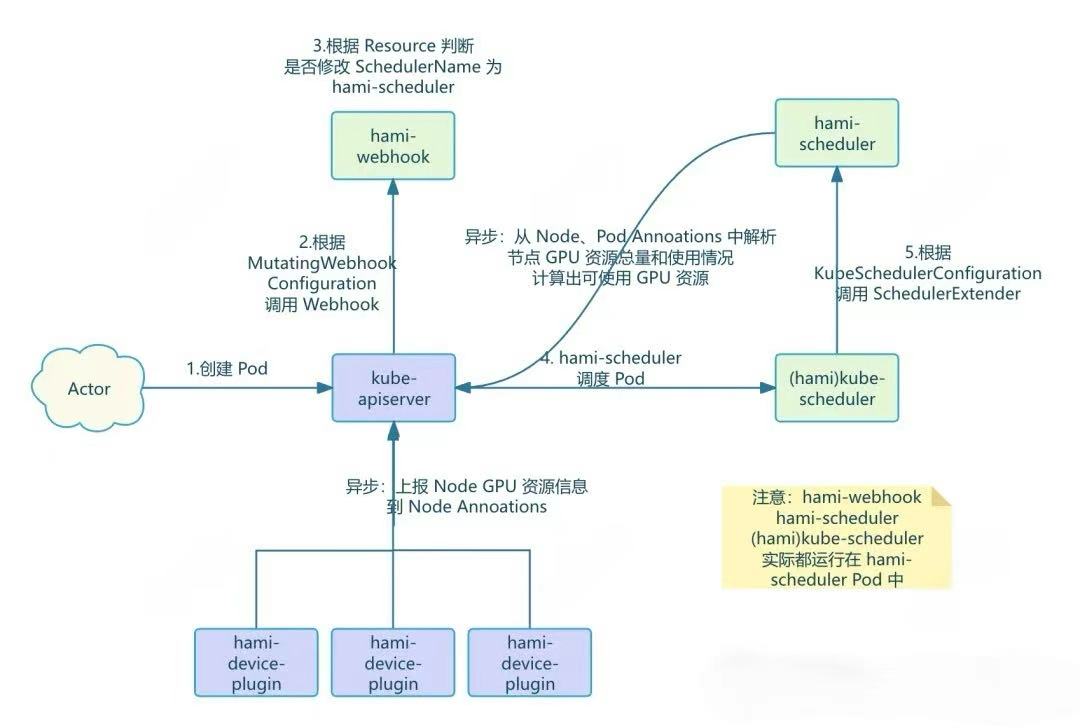
-
用户创建 Pod 并在 Pod 中申请了 vGPU 资源
-
kube-apiserver 根据 MutatingWebhookConfiguration 配置请求 HAMi-Webhook
-
HAMi-Webhook 检测 Pod 中的 Resource,如果申请的由 HAMi 管理的 vGPU 资源,就会把 Pod 中的 SchedulerName 改成了 hami-scheduler,这样这个 Pod 就会由 hami-scheduler 进行调度了。
-
对于特权模式的 Pod,Webhook 会直接跳过不处理
-
对于使用 vGPU 资源但指定了 nodeName 的 Pod,Webhook 会直接拒绝
- hami-scheduler 进行 Pod 调度,不过就是用的 k8s 的默认 kube-scheduler 镜像,因此调度逻辑和默认的 default-scheduler 是一样的,但是 kube-scheduler 还会根据 KubeSchedulerConfiguration 配置,调用 Extender Scheduler 插件
-
这个 Extender Scheduler 就是 hami-scheduler Pod 中的另一个 Container,该 Container 同时提供了 Webhook 和 Scheduler 相关 API。
-
当 Pod 申请了 vGPU 资源时,kube-scheduler 就会根据配置以 HTTP 形式调用 Extender Scheduler 插件,这样就实现了自定义调度逻辑
- Extender Scheduler 插件包含了真正的 hami 调度逻辑,调度时根据节点剩余资源量进行打分选择节点
- 这里就包含了 spread & binpark 等 高级调度策略的实现
- 异步任务,包括 GPU 感知逻辑
-
devicePlugin 中的后台 Goroutine 定时上报 Node 上的 GPU 资源并写入到 Node 的 Annoations
-
除了 DevicePlugin 之外,还使用异步任务以 Patch Annotation 方式提交更多信息
-
Extender Scheduler 插件根据 Node Annoations 解析出 GPU 资源总量、从 Node 上已经运行的 Pod 的 Annoations 中解析出 GPU 使用量,计算出每个 Node 剩余的可用资源保存到内存供调度时使用
整个调度分为 Node 级别和 Card 级别,默认情况下根据配置的 Binpack、Spread 调度策略选择格式的目标。
当前通过 Annoations 指定 GPU 则是额外逻辑,需要根据 Annoations 中的配置选择合适 Card,最终再根据 Card 选择合适节点。
根据 Annoations 过滤掉不满足条件的 Card
核心逻辑在 fitInCertainDevice 方法中,挨个 Card 检测,判断其是否满足条件,包括 Core 和 Memory 是否满足 Pod 申请,以及 Annoations 中解析出的 Type 和 UUID 限制。
当一个 Node 上的所有 Card 都不满足条件时,说明当前 Node 也不满足条件,因此把 Node 也过滤掉。
最终得到满足条件的 Node 以及 Node 上满足条件的 Card,最后在根据配置的 Binpack、Spread 调度策略选择出目标节点以及 Card。
// pkg/scheduler/score.go#L65
func fitInCertainDevice(node *NodeUsage, request util.ContainerDeviceRequest, annos map[string]string, pod *corev1.Pod, allocated *util.PodDevices) (bool, map[string]util.ContainerDevices) {
    k := request
    originReq := k.Nums
    prevnuma := -1
    klog.InfoS("Allocating device for container request", "pod", klog.KObj(pod), "card request", k)
    var tmpDevs map[string]util.ContainerDevices
    tmpDevs = make(map[string]util.ContainerDevices)
    for i := len(node.Devices.DeviceLists) - 1; i >= 0; i-- {
        found, numa := checkType(annos, *node.Devices.DeviceLists[i].Device, k)
        if !found {
            continue
        }
        if numa && prevnuma != node.Devices.DeviceLists[i].Device.Numa {
            k.Nums = originReq
            prevnuma = node.Devices.DeviceLists[i].Device.Numa
            tmpDevs = make(map[string]util.ContainerDevices)
        }
        if !checkUUID(annos, *node.Devices.DeviceLists[i].Device, k) {
            continue
        }

        memreq := int32(0)
        if node.Devices.DeviceLists[i].Device.Count <= node.Devices.DeviceLists[i].Device.Used {
            continue
        }
        if k.Coresreq > 100 {
            klog.ErrorS(nil, "core limit can't exceed 100", "pod", klog.KObj(pod))
            k.Coresreq = 100
            //return false, tmpDevs
        }
        if k.Memreq > 0 {
            memreq = k.Memreq
        }
        if k.MemPercentagereq != 101 && k.Memreq == 0 {
            //This incurs an issue
            memreq = node.Devices.DeviceLists[i].Device.Totalmem * k.MemPercentagereq / 100
        }
        if node.Devices.DeviceLists[i].Device.Totalmem-node.Devices.DeviceLists[i].Device.Usedmem < memreq {
            continue
        }
        if node.Devices.DeviceLists[i].Device.Totalcore-node.Devices.DeviceLists[i].Device.Usedcores < k.Coresreq {
            continue
        }
        // Coresreq=100 indicates it want this card exclusively
        if node.Devices.DeviceLists[i].Device.Totalcore == 100 && k.Coresreq == 100 && node.Devices.DeviceLists[i].Device.Used > 0 {
            continue
        }
        // You can't allocate core=0 job to an already full GPU
        if node.Devices.DeviceLists[i].Device.Totalcore != 0 && node.Devices.DeviceLists[i].Device.Usedcores == node.Devices.DeviceLists[i].Device.Totalcore && k.Coresreq == 0 {
            continue
        }
        if !device.GetDevices()[k.Type].CustomFilterRule(allocated, request, tmpDevs[k.Type], node.Devices.DeviceLists[i].Device) {
            continue
        }
        if k.Nums > 0 {
            klog.InfoS("first fitted", "pod", klog.KObj(pod), "device", node.Devices.DeviceLists[i].Device.ID)
            k.Nums--
            tmpDevs[k.Type] = append(tmpDevs[k.Type], util.ContainerDevice{
                Idx:       int(node.Devices.DeviceLists[i].Device.Index),
                UUID:      node.Devices.DeviceLists[i].Device.ID,
                Type:      k.Type,
                Usedmem:   memreq,
                Usedcores: k.Coresreq,
            })
        }
        if k.Nums == 0 {
            klog.InfoS("device allocate success", "pod", klog.KObj(pod), "allocate device", tmpDevs)
            return true, tmpDevs
        }
        if node.Devices.DeviceLists[i].Device.Mode == "mig" {
            i++
        }
    }
    return false, tmpDevs
}
By Type
// pkg/scheduler/score.go#L38
func checkType(annos map[string]string, d util.DeviceUsage, n util.ContainerDeviceRequest) (bool, bool) {
    // General type check, NVIDIA->NVIDIA MLU->MLU
    klog.V(3).InfoS("Type check", "device", d.Type, "req", n.Type)
    if !strings.Contains(d.Type, n.Type) {
        return false, false
    }
    for _, val := range device.GetDevices() {
        found, pass, numaAssert := val.CheckType(annos, d, n)
        if found {
            return pass, numaAssert
        }
    }
    klog.Infof("Unrecognized device %s", n.Type)
    return false, false
}

func checkGPUtype(annos map[string]string, cardtype string) bool {
    cardtype = strings.ToUpper(cardtype)
    if inuse, ok := annos[GPUInUse]; ok {
        useTypes := strings.Split(inuse, ",")
        // if false return false...
        if !ContainsSliceFunc(useTypes, func(useType string) bool {
            return strings.Contains(cardtype, strings.ToUpper(useType))
        }) {
            return false
        }
    }
    if unuse, ok := annos[GPUNoUse]; ok {
        unuseTypes := strings.Split(unuse, ",")
        // if true return false
        if ContainsSliceFunc(unuseTypes, func(unuseType string) bool {
            return strings.Contains(cardtype, strings.ToUpper(unuseType))
        }) {
            return false
        }
    }
    return true
}
同样是包括 TypeUse 和 TypeNoUse 两个。
if inuse, ok := annos[GPUInUse]; ok {
    useTypes := strings.Split(inuse, ",")
    // if false return false...
    if !ContainsSliceFunc(useTypes, func(useType string) bool {
        return strings.Contains(cardtype, strings.ToUpper(useType))
    }) {
        return false
    }
}
这里的 cardtype 就是类似 NVIDIA-NVIDIA-A40 这样的格式,useType 则是用户在 Annoations 中指定的 Type。
同时这里使用 strings.Contains(cardtype, strings.ToUpper(useType)) 进行匹配,因此 Annoations 中可以指定 NVIDIA-NVIDIA-A40 这样的 fullname 或者 A40 这样 shortname。
当前 Card 不匹配 Annoations 中指定的任意一个 Use Type 时说明当前 Card 不满足条件,因此返回 false。
对于 NoUse Type 则是 只要当前 Card 匹配上 NoUse 中的任意 Card 则说明当前 Card 在 blacklist 中,也返回 false。
if unuse, ok := annos[GPUNoUse]; ok {
    unuseTypes := strings.Split(unuse, ",")
    // if true return false
    if ContainsSliceFunc(unuseTypes, func(unuseType string) bool {
        return strings.Contains(cardtype, strings.ToUpper(unuseType))
    }) {
        return false
    }
}
这样就过滤掉了不满足提交的 Card。
By UUID
UUID 也是同样的,Annoations 中解析用户指定的 Use UUID 和 NoUse UUID 列表,然后匹配当前 Card,从而过滤掉不满足条件的 Card。
// pkg/scheduler/score.go#L54
func checkUUID(annos map[string]string, d util.DeviceUsage, n util.ContainerDeviceRequest) bool {
    devices, ok := device.GetDevices()[n.Type]
    if !ok {
        klog.Errorf("can not get device for %s type", n.Type)
        return false
    }
    result := devices.CheckUUID(annos, d)
    klog.V(2).Infof("checkUUID result is %v for %s type", result, n.Type)
    return result
}

func (dev *NvidiaGPUDevices) CheckUUID(annos map[string]string, d util.DeviceUsage) bool {
    userUUID, ok := annos[GPUUseUUID]
    if ok {
        klog.V(5).Infof("check uuid for nvidia user uuid [%s], device id is %s", userUUID, d.ID)
        // use , symbol to connect multiple uuid
        userUUIDs := strings.Split(userUUID, ",")
        for _, uuid := range userUUIDs {
            if d.ID == uuid {
                return true
            }
        }
        return false
    }

    noUserUUID, ok := annos[GPUNoUseUUID]
    if ok {
        klog.V(5).Infof("check uuid for nvidia not user uuid [%s], device id is %s", noUserUUID, d.ID)
        // use , symbol to connect multiple uuid
        noUserUUIDs := strings.Split(noUserUUID, ",")
        for _, uuid := range noUserUUIDs {
            if d.ID == uuid {
                return false
            }
        }
        return true
    }

    return true
}
需要注意的是:UUID 和 Type 不一样,这里是完全匹配。
记录目标 Card 到 Annoations
fitInCertainDevice 方法过滤出合适 Node、Card 后,Scheduler 的 Bind 接口直接将 Node 和 Pod 绑定即可完成调度,但是 Card 是由 DevicePlugin 在分配的,因此在 Scheduler 中通过 Annoations 形式将 Card 记录到 Pod 上,后续 DevicePlugin 直接从 Annoations 中读取即可。
sort.Sort(nodeScores)
m := (*nodeScores).NodeList[len((*nodeScores).NodeList)-1]
klog.Infof("schedule %v/%v to %v %v", args.Pod.Namespace, args.Pod.Name, m.NodeID, m.Devices)
annotations := make(map[string]string)
annotations[util.AssignedNodeAnnotations] = m.NodeID
annotations[util.AssignedTimeAnnotations] = strconv.FormatInt(time.Now().Unix(), 10)

for _, val := range device.GetDevices() {
    val.PatchAnnotations(&annotations, m.Devices)
}
Annoations 大概是这样的:
root@test:~/lixd/hami# k get po hami-30 -oyaml
apiVersion: v1
kind: Pod
metadata:
  annotations:
    hami.io/bind-phase: allocating
    hami.io/bind-time: "1732072495"
    hami.io/vgpu-devices-allocated: GPU-1afede84-4e70-2174-49af-f07ebb94d1ae,NVIDIA,20000,30:;
    hami.io/vgpu-devices-to-allocate: GPU-1afede84-4e70-2174-49af-f07ebb94d1ae,NVIDIA,20000,30:;
    hami.io/vgpu-node: test
    hami.io/vgpu-time: "1732072495"
其中 hami.io/vgpu-devices-to-allocate 则是 Scheduler 为 Pod 选择的目标 GPU
5. DevicePlugin 解析 GPU 并分配
在调度时,我们把最终选择的 GPU 记录到了 Pod 的 Annoations 上,DevicePlugin 这边就不需要选择 GPU 了,从 Annoations 上解析即可
// pkg/util/util.go#L281
func GetNextDeviceRequest(dtype string, p corev1.Pod) (corev1.Container, ContainerDevices, error) {
    pdevices, err := DecodePodDevices(InRequestDevices, p.Annotations)
    if err != nil {
        return corev1.Container{}, ContainerDevices{}, err
    }
    klog.Infof("pod annotation decode value is %+v", pdevices)
    res := ContainerDevices{}

    pd, ok := pdevices[dtype]
    if !ok {
        return corev1.Container{}, res, errors.New("device request not found")
    }
    for ctridx, ctrDevice := range pd {
        if len(ctrDevice) > 0 {
            return p.Spec.Containers[ctridx], ctrDevice, nil
        }
    }
    return corev1.Container{}, res, errors.New("device request not found")
}

// pkg/util/util.go#L254
func DecodePodDevices(checklist map[string]string, annos map[string]string) (PodDevices, error) {
    klog.V(5).Infof("checklist is [%+v], annos is [%+v]", checklist, annos)
    if len(annos) == 0 {
        return PodDevices{}, nil
    }
    pd := make(PodDevices)
    for devID, devs := range checklist {
        str, ok := annos[devs]
        if !ok {
            continue
        }
        pd[devID] = make(PodSingleDevice, 0)
        for _, s := range strings.Split(str, OnePodMultiContainerSplitSymbol) {
            cd, err := DecodeContainerDevices(s)
            if err != nil {
                return PodDevices{}, nil
            }
            if len(cd) == 0 {
                continue
            }
            pd[devID] = append(pd[devID], cd)
        }
    }
    klog.InfoS("Decoded pod annos", "poddevices", pd)
    return pd, nil
}
具体的解析逻辑如下,就是按照预设规则,以冒号,逗号进行切分
// pkg/util/util.go#L223
func DecodeContainerDevices(str string) (ContainerDevices, error) {
    if len(str) == 0 {
        return ContainerDevices{}, nil
    }
    cd := strings.Split(str, OneContainerMultiDeviceSplitSymbol)
    contdev := ContainerDevices{}
    tmpdev := ContainerDevice{}
    klog.V(5).Infof("Start to decode container device %s", str)
    if len(str) == 0 {
        return ContainerDevices{}, nil
    }
    for _, val := range cd {
        if strings.Contains(val, ",") {
            //fmt.Println("cd is ", val)
            tmpstr := strings.Split(val, ",")
            if len(tmpstr) < 4 {
                return ContainerDevices{}, fmt.Errorf("pod annotation format error; information missing, please do not use nodeName field in task")
            }
            tmpdev.UUID = tmpstr[0]
            tmpdev.Type = tmpstr[1]
            devmem, _ := strconv.ParseInt(tmpstr[2], 10, 32)
            tmpdev.Usedmem = int32(devmem)
            devcores, _ := strconv.ParseInt(tmpstr[3], 10, 32)
            tmpdev.Usedcores = int32(devcores)
            contdev = append(contdev, tmpdev)
        }
    }
    klog.V(5).Infof("Finished decoding container devices. Total devices: %d", len(contdev))
    return contdev, nil
}
至此,整个流程就完成了。
6.小结
- HAMi 提供了一个指定调度到 (或者不调度到) 某种 (个) GPU 的功能:
-
By Type:指定 GPU Type,仅调度 (或者不调度) 到某些指定 Type 的卡上,例如:A100、A40
-
By UUID:指定 GPU UUID,仅调度 (或者不调度) 到调度到特定 UUID 对应的卡上
-
通过该特性,可以实现更加精细的调度,当集群中存在多种 GPU 时比较有用
- 可以通过解析 Node Annoations 中的 hami.io.node-nvidia-register key 找到该节点上注册的 GPU 信息,例如:
root@j99cloudvm:~# node=j99cloudvm
kubectl get node $node -o jsonpath='{.metadata.annotations.hami\.io/node-nvidia-register}'
GPU-03f69c50-207a-2038-9b45-23cac89cb67d,10,46068,100,NVIDIA-NVIDIA A40,0,true:GPU-1afede84-4e70-2174-49af-f07ebb94d1ae,10,46068,100,NVIDIA-NVIDIA A40,0,true:
- 匹配规则:
-
对于 Type 当前使用 strings.Contains 方式,因此可以指定 Type 的 fullnameNVIDIA-NVIDIA A40,或者 shortname A40
-
对于 UUID 则是完全匹配,必须一致才行
- 如果 Annoations 填写错误,比如指定了一个不存在的 UUID 或者 Type 则会导致调度失败,Pod 处于 Pending 状态。
想了解更多 HAMi 项目信息,请访问 GitHub 仓库 或加入我们的 Slack 社区。