


How SeresCloud scaled AI inference to 10 billion daily tokens with Kubernetes and HAMi
Up from approximately 300 million to over 10 billion
HAMi plus platform autoscaling, up from 15–25%
SeresCloud platform-wide growth
On this page
About Seres and SeresCloud
Seres is a technology-driven automaker focused on new energy vehicles. As AI adoption expanded across its business, the company built SeresCloud to provide unified model services for internal applications and AI agents, with Kubernetes managing the underlying GPU resources.
During 2026, the number of models in service grew from around 10 to more than 42, while daily token volume increased from approximately 300 million to over 10 billion. This platform-wide growth made GPU efficiency, especially for small-model inference, a priority.
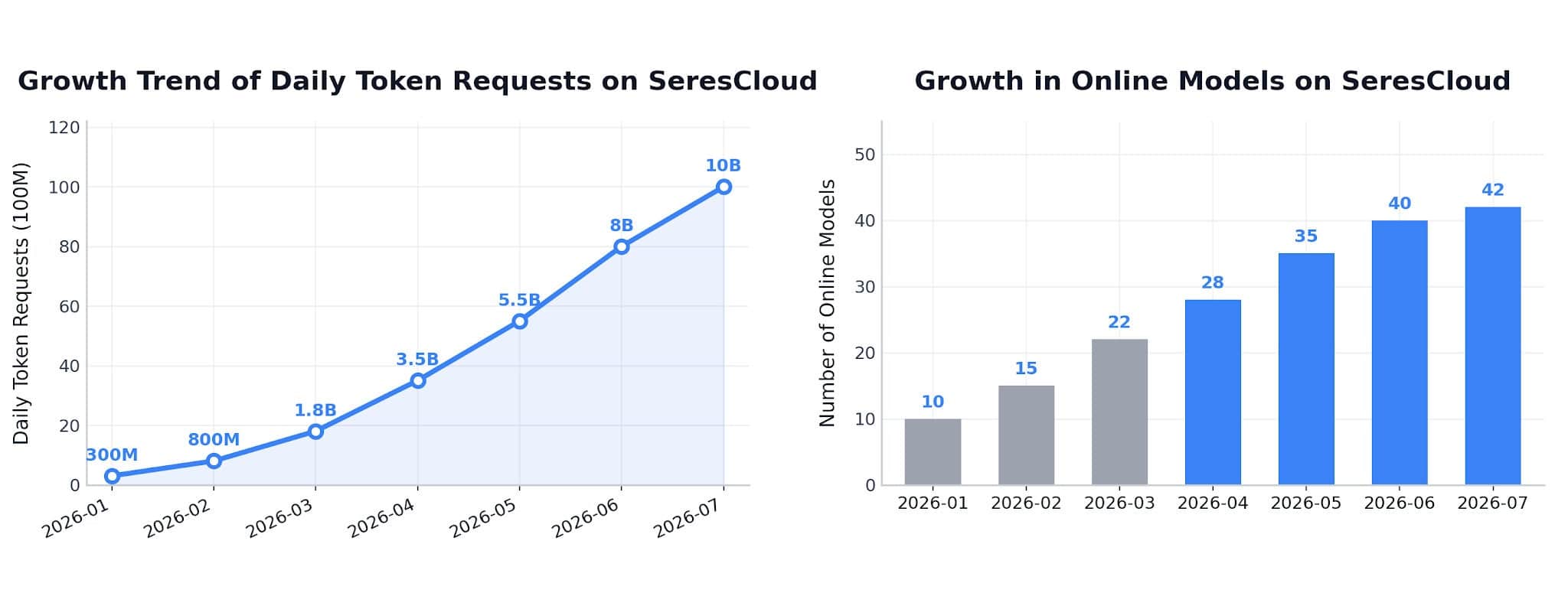
Growth in SeresCloud model count and daily token volume
Why whole-GPU allocation fell short
The existing environment used GPU-Operator for device management and MIG on supported A100 and H100 GPUs. As hardware and models diversified, whole-GPU allocation was too coarse for embedding, reranking, voice and OCR workloads. Individual inference workloads often needed only 1–4 GB of GPU memory and followed strong day–night traffic patterns. GPU utilization in these small-model scenarios was typically just 15–25% under exclusive allocation.
Time-slicing enabled sharing, but without clear memory and compute boundaries it introduced contention, out-of-memory failures and latency jitter. Seres needed better utilization with more predictable resource limits for multi-tenant inference.
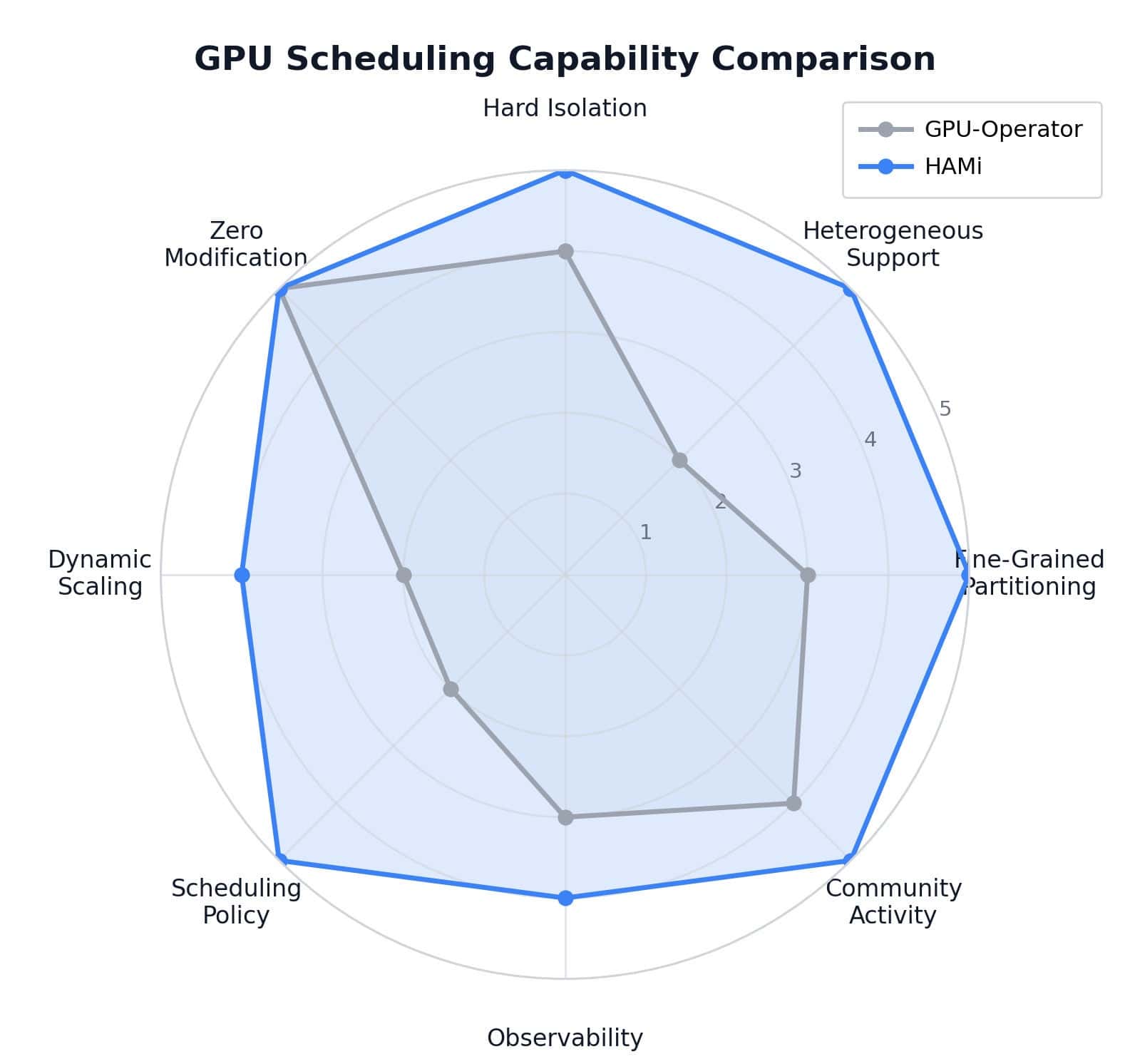
Comparison of GPU resource allocation approaches
Combining HAMi with platform autoscaling
SeresCloud already provided a model registry, inference gateway, autoscaling and monitoring. The registry managed images, configurations and versions. The gateway handled routing, load balancing, rate limiting and circuit breaking. Autoscaling adjusted service replicas using QPS, GPU utilization and queue depth.
With HAMi, the platform determines when to scale and how many replicas are needed. HAMi places those replicas on suitable GPUs and applies per-task GPU memory and compute limits. Shared monitoring signals connect service elasticity with fine-grained resource allocation.
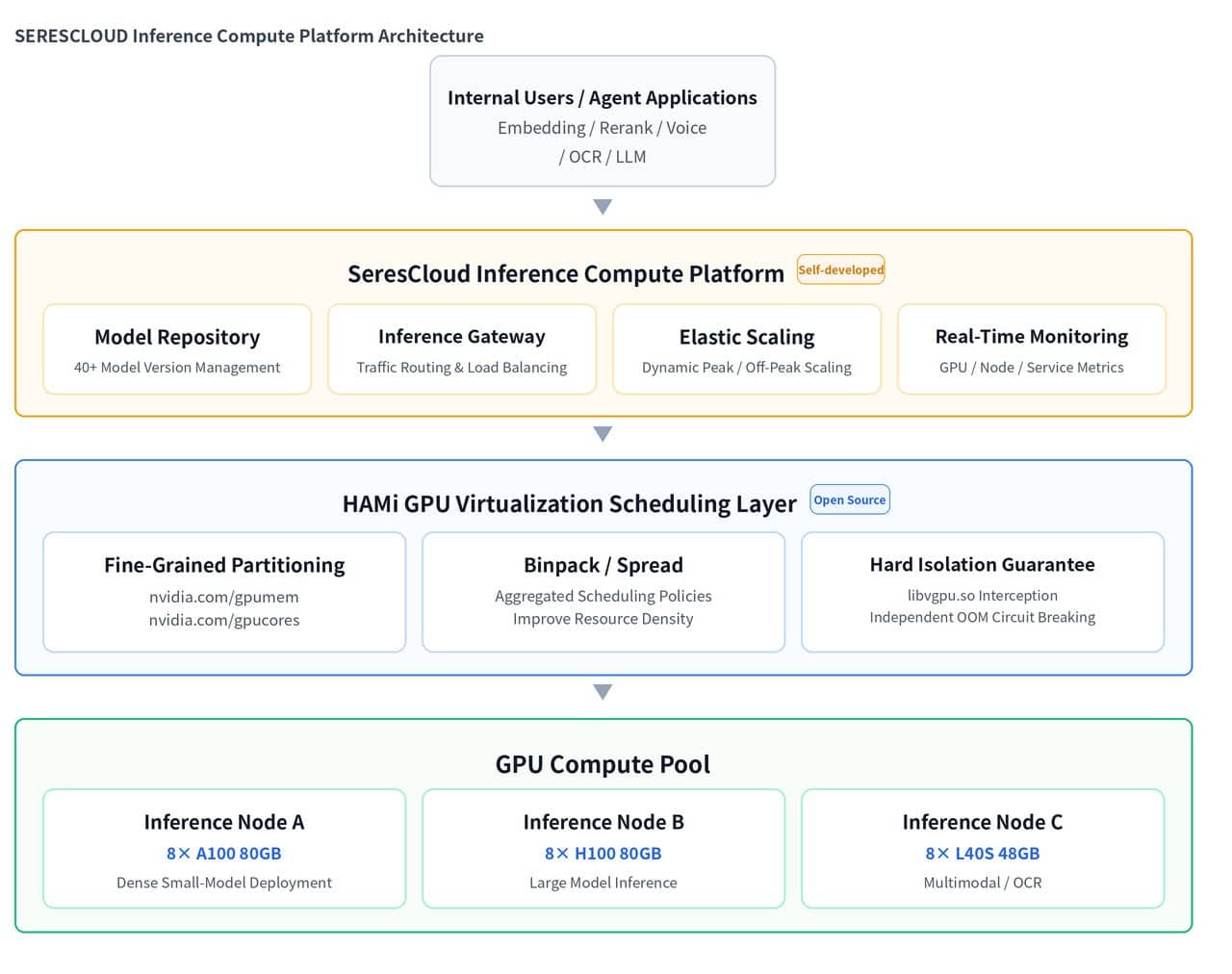
How the SeresCloud inference platform integrates HAMi
Sharing one GPU across inference workloads
With HAMi, a Kubernetes Pod can request a vGPU count, GPU memory and a share of compute. The example below requests one vGPU, 3,000 MiB of GPU memory and 30% compute, allowing a small model to use the resources it needs without reserving a whole GPU.
resources:
  limits:
    nvidia.com/gpu: 1
    nvidia.com/gpumem: 3000
    nvidia.com/gpucores: 30
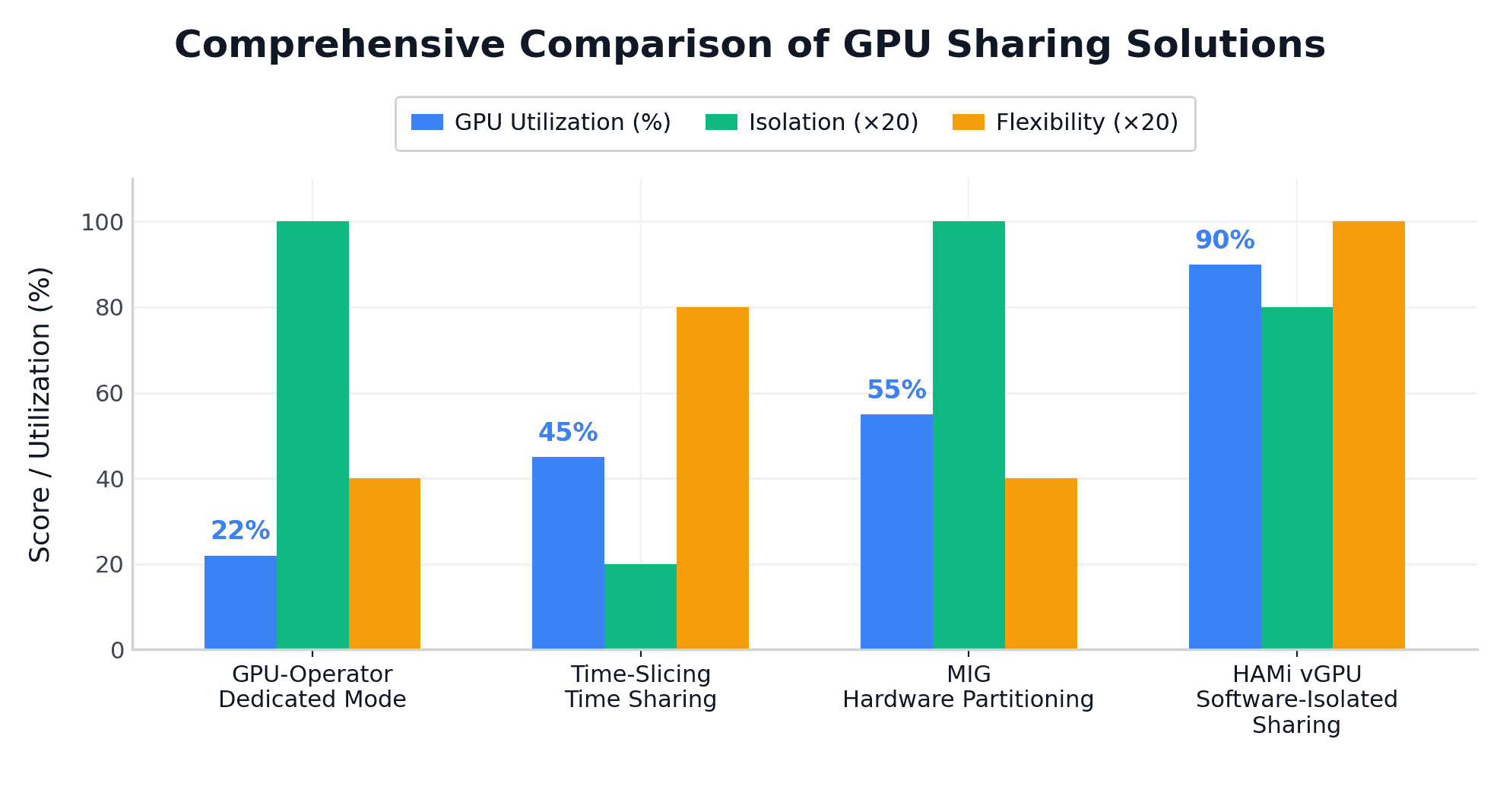
From exclusive GPUs to sharing with resource boundaries
Scheduling and production configuration
Seres uses both Binpack and Spread strategies in production, selecting placement according to workload requirements. Load testing led to a limit of 10 vGPU tasks per physical GPU, with no memory or compute oversubscription. More task slots do not create additional physical resources: scheduling still checks the resources available on each device.
devicePlugin:
  deviceSplitCount: 10
  deviceMemoryScaling: 1
  deviceCoreScaling: 1
  migStrategy: none
  disablecorelimit: "false"

scheduler:
  defaultMem: 5000
  defaultCores: 0
Small-model inference GPU utilization reaches around 90%
Together, HAMi and SeresCloud autoscaling increased GPU utilization in small-model inference scenarios from 15–25% to around 90%. Across the platform, daily token volume grew by more than 3,000% to over 10 billion, with more than 42 models in service. Better resource efficiency supported the platform as its AI workloads expanded.
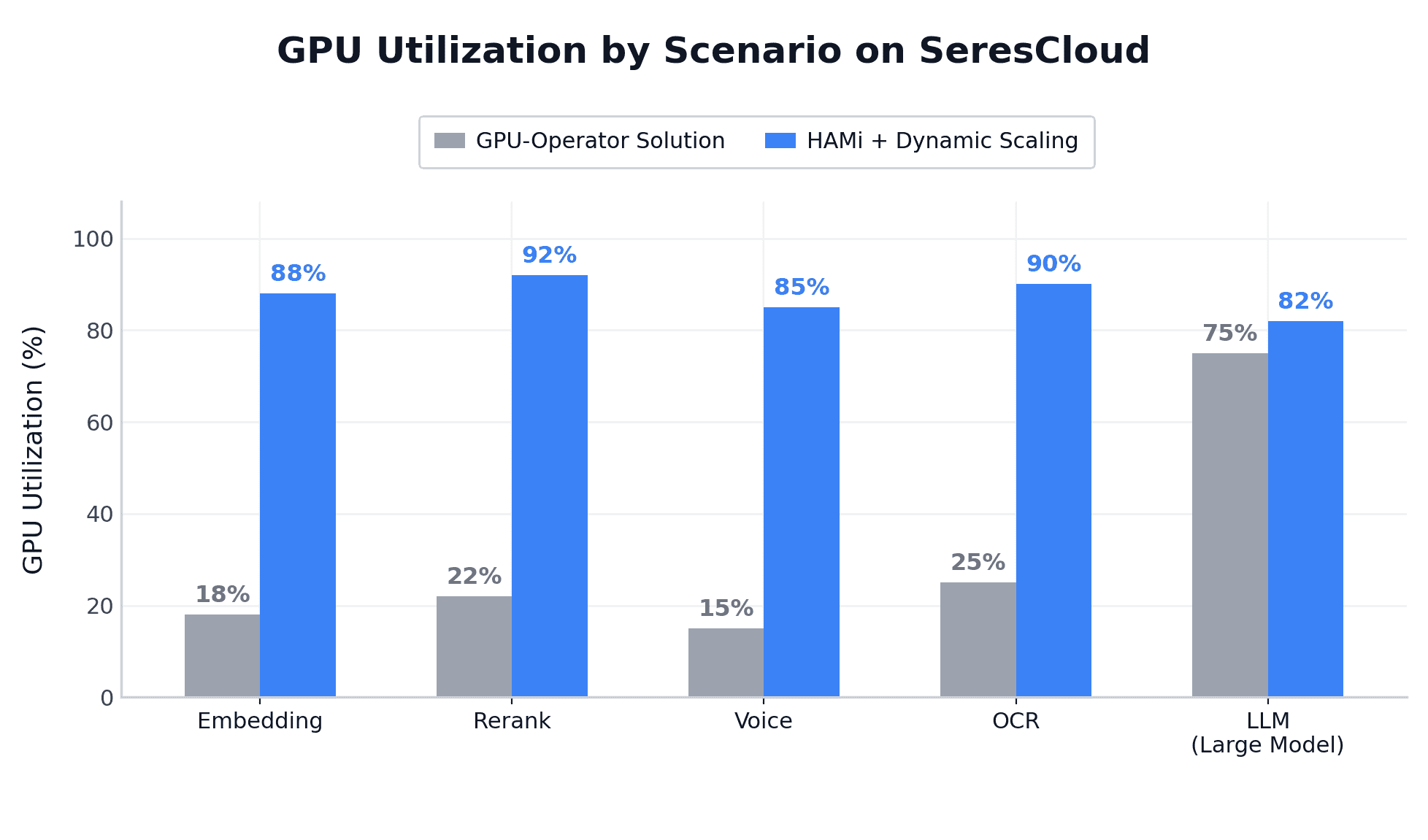
GPU utilization in small-model inference scenarios
Lessons from production
During rollout, the team configured webhook bypass rules for privileged debugging Pods and diagnosed scheduling failures using reasons such as NodeInsufficientDevice, CardTypeMismatch and CardInsufficientMemory. Prometheus and Grafana brought HAMi and platform metrics together so troubleshooting, placement and autoscaling could use consistent signals.
The number of device slices must be validated against real models, concurrency and service quality; a larger number is not automatically better. Clear responsibilities between platform autoscaling and HAMi scheduling, supported by shared monitoring, are central to stable operation.
Next steps: broader hardware and scheduling support
Seres plans to bring Ascend and Hygon DCU devices into its resource pools, evaluate HAMi-DRA and explore priority-based preemption and topology-aware scheduling for larger models. The team also plans to continue sharing production experience with the open-source community.
Original:How SeresCloud Scaled AI Inference to 10 Billion Daily Tokens with Kubernetes and HAMi ↗
Publisher: Cloud Native Computing Foundation (CNCF) · 2026-11-02
This localized edition preserves the source article’s technical information and measurement scope. It is not an official CNCF translation. Architecture diagrams retain their original text. Project status and product information reflect the original publication date.
The original is used under the Linux Foundation content terms and CC BY 3.0. This edition has been localized and reformatted. All brand marks belong to their respective owners.