

Dynamia HAMi x Kunlunxin P800 Complete Compatibility Mutual Recognition
 Product
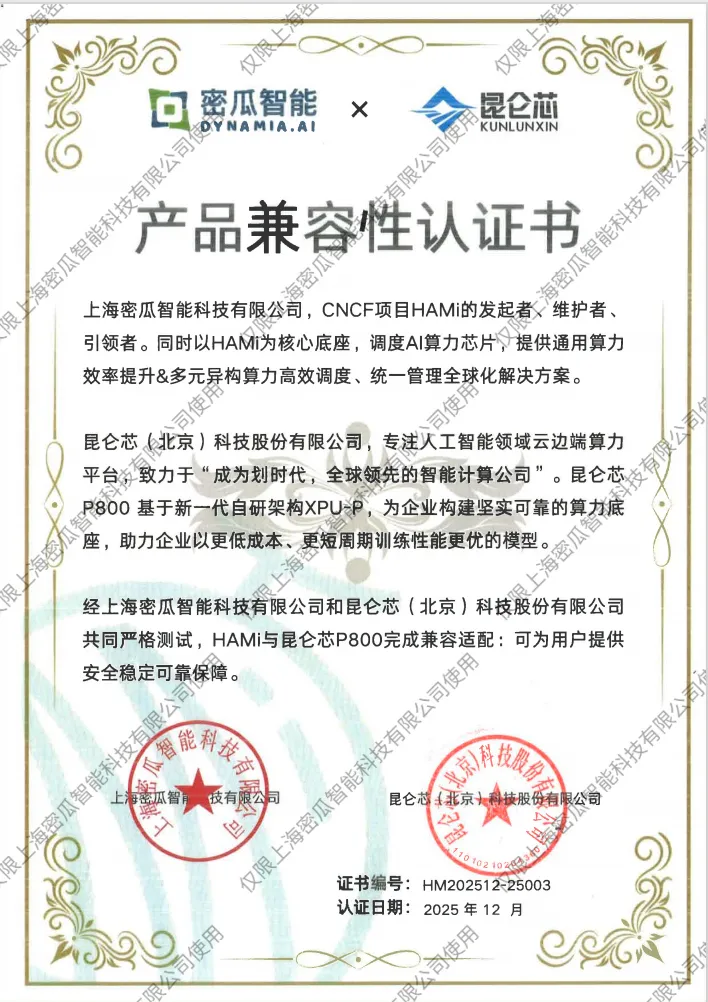
Recently, Dynamia and Kunlunxin (XPU) completed phased product compatibility testing and mutual recognition around collaborative adaptation and engineering validation of domestic AI accelerators and AI infrastructure software.
On this page
Product Compatibility Mutual Recognition
Recently, Shanghai Dynamia Intelligent Technology Co., Ltd. (hereinafter "Dynamia") and Kunlunxin (Beijing) Technology Co., Ltd. (hereinafter "Kunlunxin") completed phased product compatibility testing and mutual recognition around collaborative adaptation and engineering validation of domestic AI accelerators and AI infrastructure software.
Through joint testing and validation by both teams, Dynamia's HAMi has completed compatibility adaptation with the Kunlunxin P800. It performed well across related test items including functional availability, system stability, resource scheduling, and compatibility, and can support typical production scenarios such as AI inference and model training.
This compatibility mutual recognition was completed through collaboration in real engineering environments. During adaptation and validation, the Kunlunxin team actively participated in HAMi's technical integration and test verification, conducting joint tuning around key capabilities such as heterogeneous compute scheduling, resource isolation, and efficiency improvement, and advancing the practical adoptability and continuous evolution of these capabilities in real business scenarios.
Going forward, Dynamia will continue to advance HAMi's adaptation and mutual certification with more domestic AI chip and accelerator vendors. By combining open-source community and industry collaboration, it aims to provide users with stable, open, and selectable domestic compute infrastructure solutions and help AI applications scale into production.
Enterprise Products Also Complete Kunlunxin Adaptation
At the same time, based on the HAMi technology foundation, Dynamia's HAMi Enterprise Edition and HAMi Platform Edition have also completed adaptation and validation for the Kunlunxin P800, and can run stably in real production environments.
While maintaining consistency with HAMi's open-source capabilities, the enterprise products further strengthen stability, operations management, and production assurance for large-scale deployment, supporting enterprises and intelligent computing centers in meeting end-to-end needs—from PoC validation to production rollout—when using domestic AI accelerators such as Kunlunxin.
About Kunlunxin
Kunlunxin (Beijing) Technology Co., Ltd. originated from Baidu's Intelligent Chip and Architecture Department. It completed an independent financing round in April 2021 at a first-round valuation of about RMB 13 billion. The team was among the earliest in China to enter AI acceleration, with more than a decade of deep work, and is an AI chip company with strong accumulation across architecture, chip implementation, software systems, and scenario applications.
About Dynamia
Shanghai Dynamia Intelligent Technology Co., Ltd. focuses on GPU virtualization and heterogeneous compute scheduling to improve compute utilization in AI scenarios. The company initiated and leads the CNCF open-source project HAMi—the industry's only open-source project that delivers flexible, on-demand, elastic, and reliable GPU virtualization—and already supports mainstream AI chip ecosystems.