

How Can One GPU Cluster Support Different Enterprise AI Workloads?
 Engineering
Enterprise GPU clusters support training, online inference, offline batch processing, and R&D. Allocation must reflect task deadlines, priorities, and isolation requirements, with costs evaluated against business outcomes.
On this page
In an AI pilot, the first question is whether a model can accomplish a task. Once it joins customer support, a knowledge base, or an R&D workflow and handles real requests every day, the questions change: can it respond promptly at peak times? Will costs remain acceptable as usage grows? Compute costs accrue through GPU-hours, electricity, and operations, while the business needs a continuously delivered service. Token economics asks precisely this: with quality and latency requirements met, how much useful inference output can the same compute investment deliver?
Yet enterprise GPUs usually do more than generate tokens. The same investment often supports training, batch processing, and R&D. To understand the economics, first identify what each task must deliver and when these tasks compete for resources.
How should one GPU cluster allocate resources across these tasks to meet business requirements while keeping compute costs under control?
Common tasks in enterprise GPU clusters
In practice, enterprise GPU workloads broadly fall into four categories.
1. Model training and fine-tuning
Enterprises train, fine-tune, and optimize models for their business data and application needs. Examples include fine-tuning on internal data and training specialized models for industry-specific scenarios.
These tasks typically require substantial GPU compute and memory. Some large-scale training jobs also require multiple GPUs working together.
2. Online inference services
Once deployed, models must continuously handle requests from users and business systems. Customer support, enterprise knowledge bases, agents, large-model APIs, OCR, and embedding services can all fall into this category.
These tasks must respond promptly. Their resource requirements depend on model size, concurrent requests, and traffic peaks, making response speed, service stability, and concurrency handling particularly important.
3. Offline inference and batch computing
Enterprises also use models to process documents in batches, analyze business data, generate content, and evaluate models.
Unlike online services, these tasks usually do not need immediate results. They can run in batches according to business schedules, with a focus on overall processing efficiency, completion time, and resource cost.
4. R&D testing and experiments
Algorithm and development teams also need GPUs for model debugging, parameter experiments, validation, and performance testing, such as model experiments in notebooks.
Their resource needs are often variable: they may request a GPU briefly or run for a long time. When several teams experiment concurrently, resource quotas and fair access also matter.
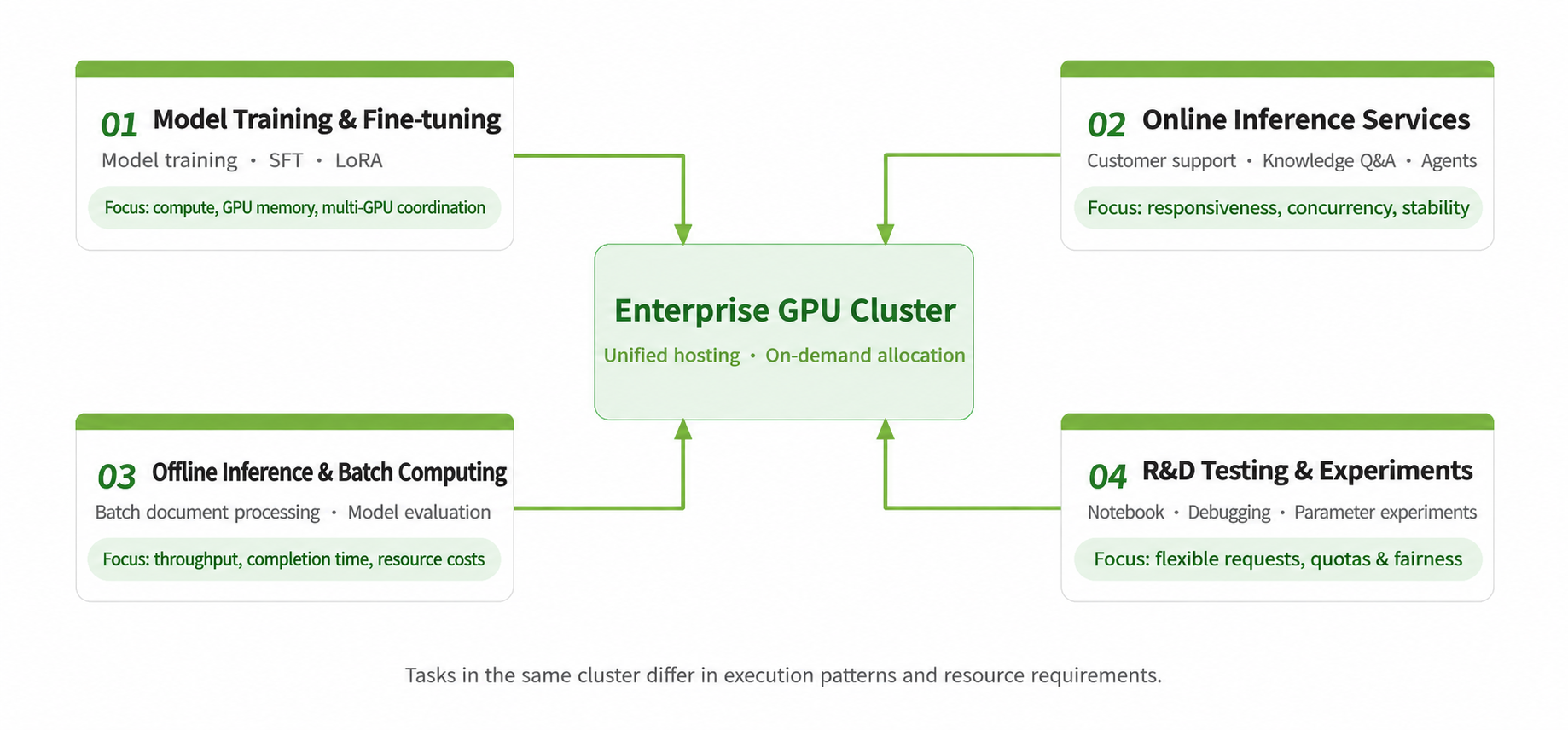
Enterprise GPU clusters support many kinds of tasks, from model training and production inference to R&D experiments, rather than just a single model or service.
These workloads are not merely theoretical categories; they also appear clearly in real production clusters.
A study published at SC 2021 analyzed SenseTime's Helios GPU datacenter. It covered four clusters, 802 compute nodes, and 6,416 GPUs, recording approximately 3.36 million jobs from April to September 2020.
The study found diverse workloads, including model training, inference, data preprocessing, and model quantization, serving both product development and research.
Enterprise GPU clusters therefore handle complex workloads spanning model development, deployment, and optimization, rather than just training or online inference.
One AI application can involve several kinds of tasks
Different workloads do not necessarily belong to different business systems. A complete AI application often requires several stages working together.
Consider enterprise knowledge-base Q&A:
- Offline preparation: Process enterprise documents, vectorize them with an embedding model, and build a knowledge-base index.
- Online service: After a user asks a question, perform semantic retrieval; some architectures also use a reranking model to filter results before a large language model generates the answer.
- Continuous improvement: Developers continually refine model and retrieval results through testing and evaluation.
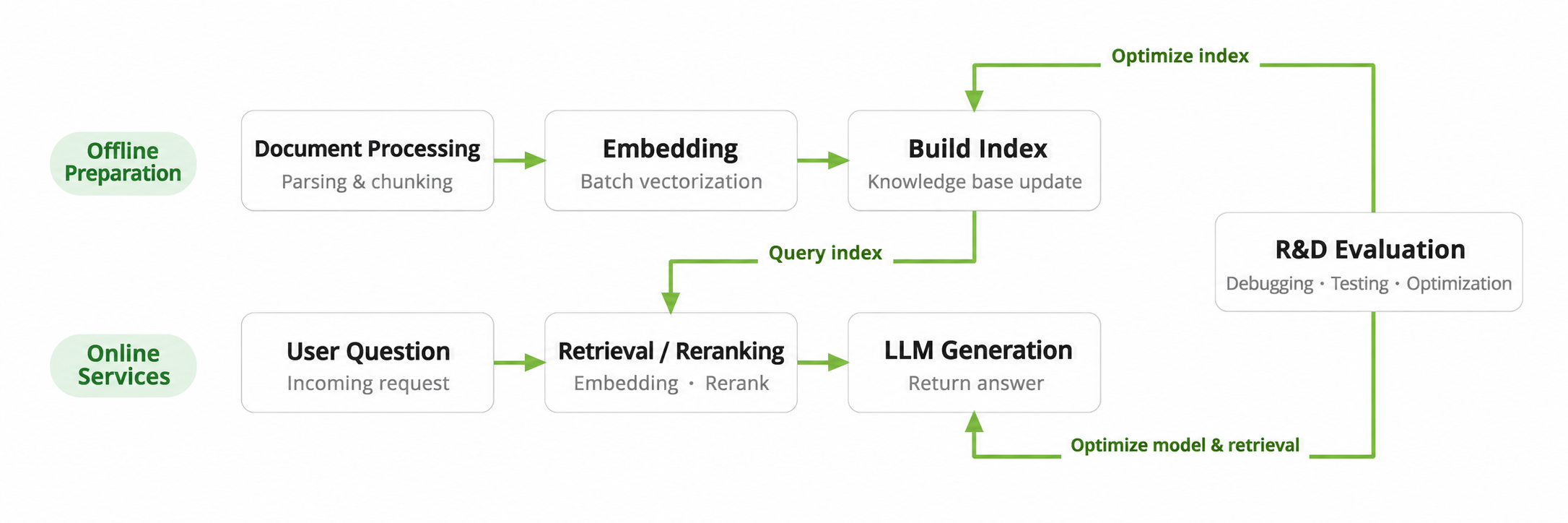
One cluster can support different applications because compute is managed in a common resource pool, while allocation policies can differ according to each task's deadlines, priorities, and isolation requirements.
If online Q&A suddenly sees a traffic peak while documents await background indexing, the platform can prioritize the online service. Offline tasks can run outside peak hours as long as update deadlines are met. This reduces user waiting time while ensuring background work finishes on time.
Within the same workflow, large-model generation may require an entire GPU or several GPUs working together. Smaller embedding or reranking services can share resources at finer granularity once concurrency and isolation requirements have been validated. The same infrastructure manages these resources centrally while allocating compute according to each task's needs.
A single knowledge-base application involves offline batch processing, real-time inference, and R&D testing. These tasks may use different models, run at different times, and need different GPU resources.
Managing enterprise GPUs therefore requires understanding the tasks behind the models, not simply counting deployed models.
Different tasks have different GPU requirements
AI tasks differ in how they run and in the resources they need.
Beyond model size and GPU memory capacity, computation patterns, response deadlines, execution cycles, and isolation requirements also affect GPU allocation.
- Model training and fine-tuning:
Typically require sustained GPU compute and memory, sometimes across multiple GPUs. Training throughput, completion time, and stability are key concerns.
- Online inference services:
Must continuously respond to users. Model size and request concurrency drive resource needs, with a focus on response speed, service stability, and performance isolation.
- Offline inference and batch computing:
Can usually run in planned batches. Overall efficiency, completion time, and resource cost matter more than the latency of an individual request.
- R&D testing and experiments:
Have more flexible resource requirements. GPUs may be requested temporarily, and the amount needed varies with experiment size. Team quotas and fair allocation must also be considered.
Even different phases of inference in the same large language model can have different needs. The Splitwise study (ISCA 2024) divides LLM inference into prefill and decode: prefill is more compute-intensive, while decode depends more on memory bandwidth.
These distinctions are not absolute. Small-model inference may still need substantial resources at high concurrency, and batch jobs can have strict deadlines. Actual requirements must be assessed against model size, runtime parameters, and business objectives.
Therefore, GPU requirements depend not only on model size, but also on how a task runs, how quickly results are needed, and how long resources remain occupied.
From workload differences to compute resource management
Different tasks have different requirements, further shaped by model size, business concurrency, execution phase, and service objectives.
McKinsey's 2026 report The cost of intelligence: How to scale AI inference likewise argues that enterprise AI infrastructure needs should start with concrete business outcomes. Retail recommendations may require large volumes of affordable requests, whereas autonomous driving has stricter real-time and reliability requirements. The infrastructure capabilities needed are different.
When different tasks enter the same GPU cluster, enterprises must also consider:
1. Multiple tasks running concurrently
Training, inference, and R&D experiments may use GPUs at the same time. Cluster management must balance their resource needs and execution priorities.
2. Business workloads keep changing
Permanently fixed allocations can leave some resources idle while other tasks lack capacity.
3. Multiple teams share the cluster
Enterprises must account for team quotas, task priorities, resource usage, and allocation fairness to prevent a few tasks or teams from occupying GPUs for long periods.
Return to the knowledge-base example. If GPUs are permanently reserved separately for online Q&A, offline indexing, and R&D evaluation, Q&A may still queue at peak times while another set of GPUs sits idle because indexing has not started. Unified management can reserve whole-GPU or multi-GPU capacity for peak generation demand, share resources among lightweight services that have passed concurrency and isolation validation, and schedule flexible indexing jobs off-peak while meeting update deadlines. The key is unified resource management with task-specific allocation policies.
Whole-GPU allocation, hardware partitioning, and software sharing each suit different scenarios. No single approach fits every task. Choices should reflect model size, performance requirements, actual resource use, and business objectives.
How should two approaches be compared? First hold business conditions constant: comparable answer quality, acceptable peak response times, and timely index updates. Then compare how many requests the same budget can serve, or how many GPUs must be reserved for the same workload. Online inference can be measured by cost per million useful output tokens or per answer meeting requirements. Offline tasks care more about meeting completion deadlines, while R&D must consider waiting time before resources become available. Only by considering these outcomes together can we judge how much business one cluster actually supports.
The calculation also extends into the future. If the generation model changes next year, traffic grows, or new device generations join the cluster, how can today's compute investment still be used? Within confirmed hardware compatibility and performance limits, enterprises need to rearrange workloads on their existing foundation rather than create another resource pool for every model or application. This is why Dynamia focuses on unified compute management: enabling resources already purchased to keep delivering as the business changes.
In the next article, we will focus on workloads suited to sharing, introduce the main GPU-sharing technologies, and discuss the metrics enterprises should validate when choosing an approach.
Research and references:
[1] Characterization and Prediction of Deep Learning Workloads in Large-Scale GPU Datacenters
https://arxiv.org/pdf/2109.01313
[2] Splitwise: Efficient Generative LLM Inference Using Phase Splitting
https://arxiv.org/html/2311.18677v2
[3] Scaling AI inference
https://www.mckinsey.com/industries/semiconductors/our-insights/scaling-ai-inference#/