
Dynamia Invited to COPU Regular Meeting: AI Agents Accelerate Adoption, Compute Infrastructure Faces a Critical Opportunity
 Community
On April 14, Dynamia was invited to a regular meeting of the China OSS Promotion Union (COPU), where it shared on AI Agent trends and heterogeneous compute scheduling, joining industry partners to discuss the critical shift of AI from "conversational ability" to "execution ability."
On this page
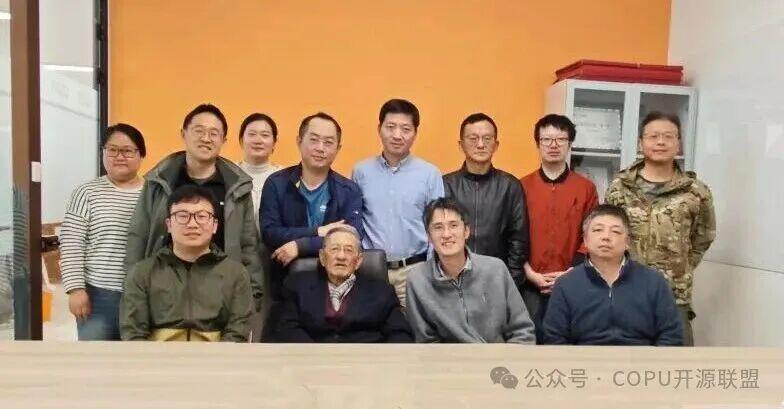
On April 14, a COPU regular meeting chaired by Lu Shouqun was held in Beijing.
The meeting was chaired by Lu Shouqun, Honorary Chairman of the China OSS Promotion Union. Lu has long advanced the development of China's internet and open-source efforts. He currently serves as Honorary Chairman of the China OSS Promotion Union and Chair of its Expert Committee, and concurrently as Vice President of the China Federation of Industrial Economics and Director of the Beijing Network Multimedia Laboratory, among other roles. He is one of the key drivers of China's open-source and digital-economy development.
The China OSS Promotion Union (China OSS Promotion Union, COPU for short) was founded in 2004. Under the guidance of government authorities, it is an open-source industry alliance jointly formed by enterprises, research institutions, and open-source communities. It has long worked to advance the application and development of open-source technology in China, foster coordination among industry, policy, and community, and serve as an important bridge between China's open-source ecosystem and the global open-source system.
Zhang Xiao, Founder and CEO of Dynamia, and Li Mengxuan, Co-founder and CTO, were invited to attend and delivered a featured sharing on AI Agent trends and heterogeneous compute scheduling.
This meeting focused on a rapidly forming industry consensus:
AI is moving from "conversational ability" to "execution ability," and AI Agents are becoming the entry point to a new generation of infrastructure.
AI Agents: Entering Enterprise Adoption and Systems Competition
The meeting focused on the development of global AI Agent platforms, including representative platforms such as Anthropic, DeepSeek, Google, and OpenAI.
Unlike earlier competition on single-point capabilities, AI Agents have now entered:
- A systems-capability competition stage (System vs Model)
- An enterprise-scenario-driven stage (B2B First)
- A multi-agent collaboration stage (Multi-Agent Native)
One clear trend:
Enterprise applications are becoming the primary battlefield for AI Agents.
From "Generation" to "Execution": AI Is Crossing a Critical Divide
The meeting noted that 2026 will be an important turning point in the AI technology path:
- From generating content → executing tasks
- From language models → system capabilities
- From tools → agents
Next-generation frameworks represented by OpenClaw are enabling AI to connect directly to operating systems and real environments, marking:
AI's shift from "decision support" to "automated execution."
This is not only a capability upgrade, but a change in the paradigm of the entire AI industry.
Dynamia: Building the Compute Foundation for the AI Agent Era
At this meeting, Dynamia focused on sharing:
Compute scheduling and resource reuse practices for small models and heterogeneous environments
As AI Agents evolve, the compute side is undergoing structural change:
- Tasks are becoming more fragmented and concurrent
- Multi-agent systems increase scheduling complexity
- Heterogeneous compute is becoming mainstream (domestic and international side by side)
Under this trend, the traditional "whole-card exclusive" resource model can no longer keep up.
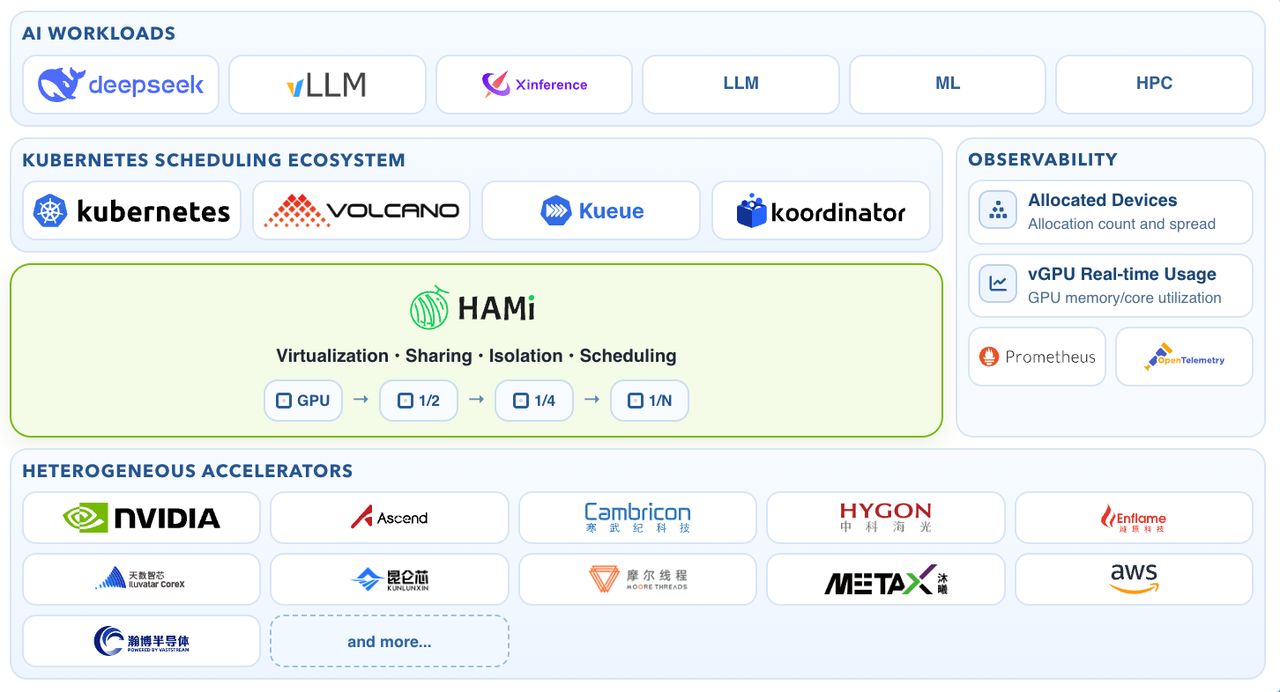
The open-source project HAMi continues to evolve against this backdrop:
- Supports multiple models sharing a single GPU, significantly improving resource utilization
- Provides unified heterogeneous compute scheduling and management
- Lowers the barrier to using and operating AI infrastructure
Today:
- Serves 250+ enterprise users
- Community contributors spanning 17+ countries
- Deployed on more than 200,000 nodes
- Has entered the CNCF ecosystem and appeared at KubeCon EU 2026
An Emerging Consensus
This meeting sent a clear signal:
AI competition is moving from the model layer, to the system layer, and on to the infrastructure layer.
Along this path:
- AI Agents are the entry point
- System orchestration is the core
- Compute scheduling is the foundation
Looking Ahead
Going forward, Dynamia will continue to focus on:
- Heterogeneous compute scheduling
- Standardization of AI infrastructure
- Open-source ecosystem collaboration
to drive efficient adoption of AI capabilities in real business scenarios.