Dynamia x OpenCSG Strategic Partnership: From Model Hosting to Compute-Native, Building Enterprise-Grade Heterogeneous Compute Scheduling Foundation
As large model applications enter the scale-up stage, enterprise requirements for model platforms are undergoing structural changes—from model asset management to model runtime and service capabilities.
When inference, fine-tuning, and Agent workloads truly run in production environments, a long-overlooked issue is gradually becoming a bottleneck:
Compute scheduling and heterogeneous resource governance capabilities.
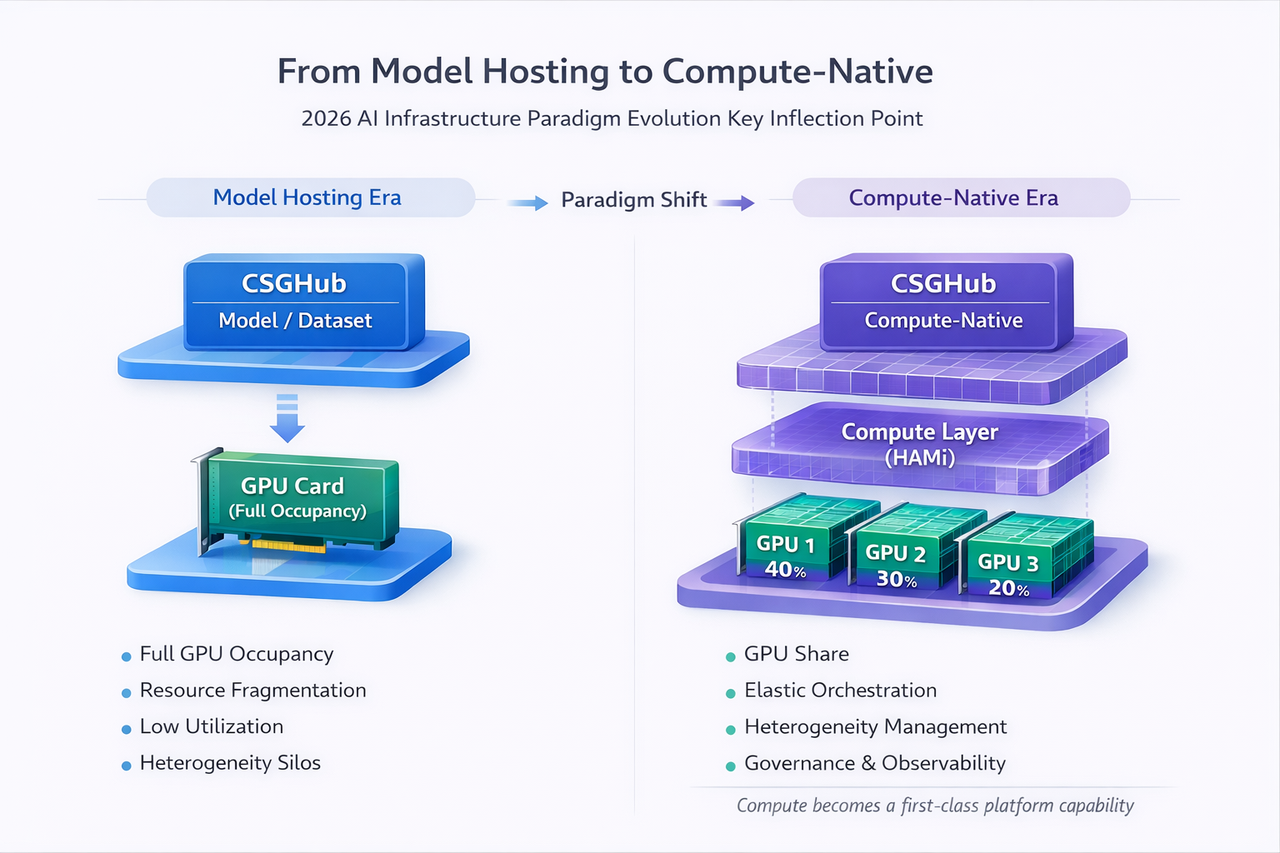
GPU resource exclusive card allocation, fragmented inference tasks, fragmented heterogeneous chips, enterprise privatization and compliance requirements... These issues all point to a trend:
Model platforms must possess "Compute-Native" capabilities to truly support enterprise-grade AI production systems.
Against this backdrop, Dynamia and OpenCSG announce a strategic partnership to jointly build a compute-native foundation for enterprise AI workloads.
Dynamia × HAMi: Heterogeneous Compute Virtualization and Scheduling Provider
Dynamia focuses on the AI infrastructure field, leading the open-source project HAMi (CNCF Sandbox project), dedicated to solving virtualization and scheduling challenges in heterogeneous GPU environments.
HAMi's core capabilities include:
- VRAM hard isolation + compute power proportional allocation, supporting fine-grained vGPU slicing
- Unified scheduling support for 9+ heterogeneous chips including NVIDIA, Ascend, Cambricon, Maxxiri, Moore Threads, and more
- Native compatibility with Kubernetes ecosystem, supporting enterprise-grade production environment deployment
As of early 2026, HAMi has attracted 360+ developers from 16 countries to contribute, and has been adopted by 300+ enterprises across finance, logistics, autonomous driving, biotechnology, and other industries. Its goal is to build the standard GPU virtualization capability layer for the AI era.
OpenCSG: From Model Community Platform to "Runtime Era"
OpenCSG's core product CSGHub has long focused on the management and distribution of models, datasets, code, and collaboration processes, serving as an important platform for model asset management.
However, as enterprise requirements upgrade, the center of gravity for model platform capabilities is shifting downward:
- Need to support online inference and concurrent multi-model execution
- Need to improve GPU utilization and reduce compute costs
- Need to support unified management of heterogeneous chip environments
- Need to meet private deployment and enterprise-grade compliance governance requirements
CSGHub is evolving from a "model hosting platform" to a "compute-native platform." This partnership marks an important step in this underlying capability upgrade.
Partnership Content: Introducing "Compute-Native" Scheduling Layer into CSGHub
This partnership advances along three main threads: "platform native integration + enterprise deployment capabilities + community ecosystem co-building."
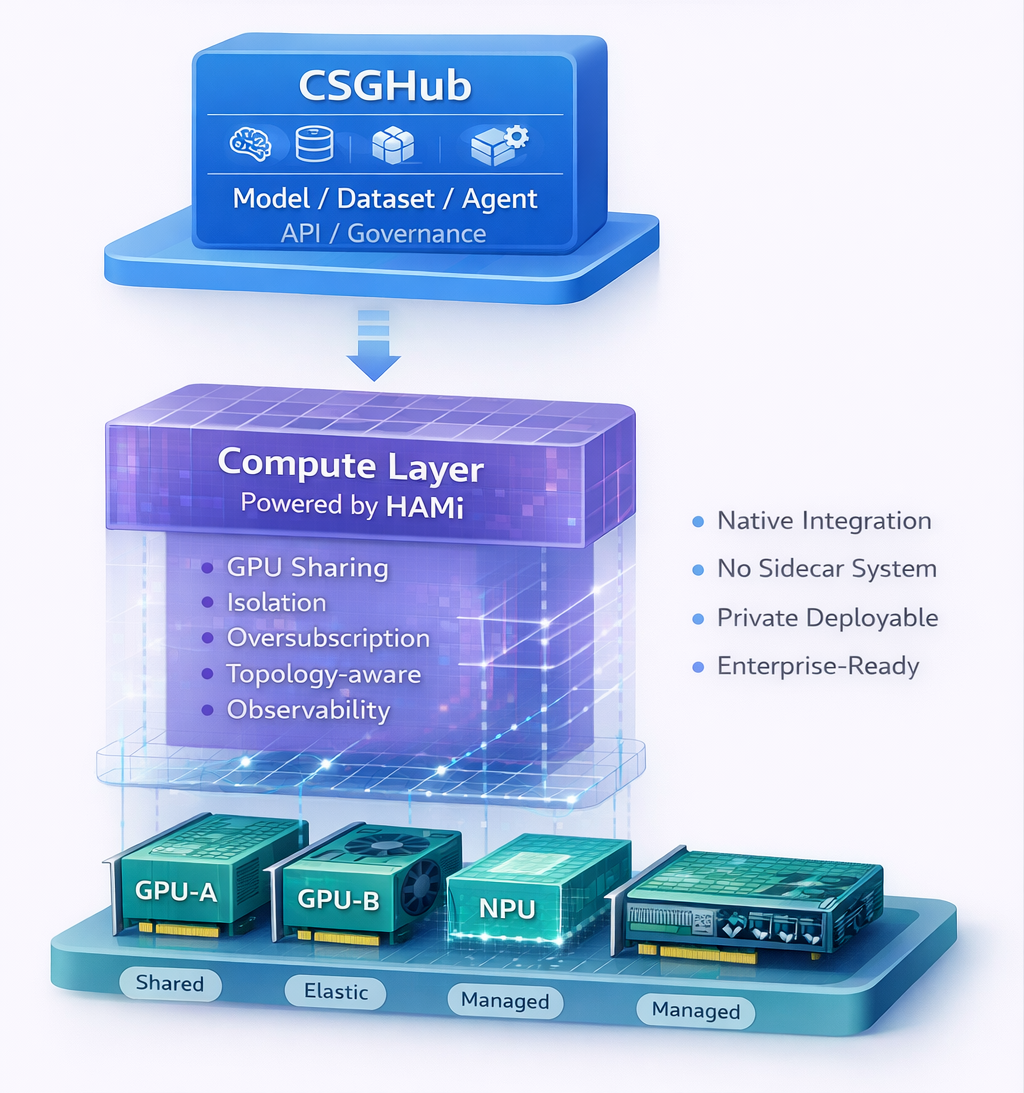
Native Integration: CSGHub × HAMi
CSGHub will integrate HAMi's heterogeneous GPU virtualization and scheduling capabilities, enabling the platform with:
- GPU sharing and elastic scheduling capabilities
- Unified management of heterogeneous chips
- Support for private deployment scenarios
This integration is not merely component docking, but achieving "compute-nativization" at the architectural level.
Enterprise Capability Enhancement
In enterprise scenarios, compute capabilities must not only "be shareable," but also:
- Governable
- Observable
- Deliverable
- Scalably evolvable
Both parties will jointly explore collaboration paths in enterprise production environments, driving GPU scheduling capabilities to truly become platform built-in capabilities rather than plug-in modules.
Open Source Ecosystem Synergy
As a CNCF Sandbox project, HAMi will continue evolving its heterogeneous compute capabilities; as a model community platform, CSGHub will provide real workload scenario feedback. This synergy mechanism will accelerate the optimization and maturation of compute scheduling capabilities in actual scenarios.
Partnership Outcomes: Native, Unified, Privately Deployable Compute Capabilities
Unlike common "plug-in" solutions, this partnership emphasizes Native Integration of compute capabilities:
- Unified deployment and lifecycle management: Compute capabilities and platform components deploy collaboratively in the same Kubernetes cluster, reducing additional systems and operational overhead
- Unified governance and observability: Sharing platform-side permissions, policies, and observability systems, transforming compute from "uncontrollable consumption item" to "governable production factor"
- Complete privatization and compliance-friendly: Meeting data security and offline deployment requirements for government, finance, healthcare, and other sectors, supporting enterprises in building stable AI production foundations in their own environments
Partnership Significance: Building an Open AI Infrastructure Ecosystem Together
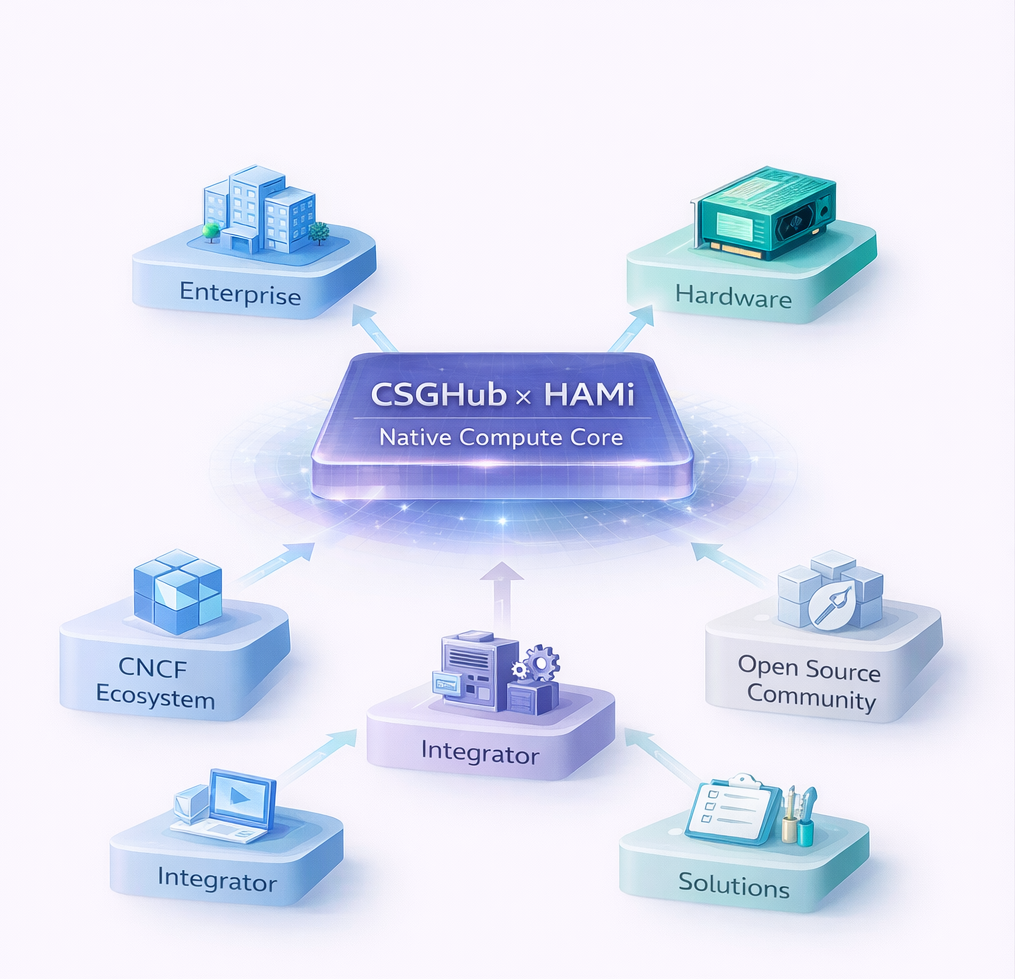
Against the backdrop of diversified domestic computing power and enhanced enterprise privatization requirements, heterogeneous GPU scheduling capability is becoming a key capability at the infrastructure layer.
The partnership between Dynamia and OpenCSG marks the deep integration of model platforms and compute foundations. Both parties will continue advancing AI infrastructure from "resource assembly" to "compute-native" around:
- Unified heterogeneous compute scheduling
- Enterprise-grade privatization capabilities
- Production-grade governance and observability systems
- Open source ecosystem collaborative evolution
Perspectives from Both Parties
Zhang Xiao (Founder and CEO of Dynamia):
"When model platforms enter the production stage, compute power is no longer about 'just buying cards,' but must be infrastructure capability that is finely governed. HAMi hopes to become the key piece for heterogeneous compute management and virtualization on Kubernetes, and our partnership with OpenCSG will deliver this capability to more enterprise users in a platform-native manner."
Chen Ran (Founder and CEO of OpenCSG):
"CSGHub's goal is not only to make models easier to manage, but also to make models easier to run and deploy at scale. Compute scheduling capability is the necessary path for platforms to become enterprise production systems. Our collaboration with Dynamia's HAMi will help us sink compute capabilities to the platform foundation, serving enterprise deployment in a more open and privatizable manner."
Next Steps
- Advance the release of deeply integrated CSGHub × HAMi version
- Validate compute-native architecture capabilities in real enterprise scenarios
- Jointly participate in open source ecosystems and industry conferences to promote standardized capability development
Get Started Today
HAMi Open Source Project
- Official website: https://project-hami.io
- Open source repository: https://github.com/project-hami/hami
- Official documentation: https://project-hami.io
CSGHub Trial Application
- Official website: https://opencsg.com/
- Open source repository: https://github.com/OpenCSGs/csghub
- Official documentation: https://opencsg.com/docs
About Dynamia
Dynamia focuses on GPU virtualization and heterogeneous compute scheduling, improving compute utilization in AI scenarios. The company initiated and leads the CNCF open-source project HAMi, the industry's only open-source project achieving flexible, on-demand, elastic, and reliable GPU virtualization, supporting mainstream AI chip ecosystems.
About OpenCSG
OpenCSG is a globally leading open-source large model community platform, dedicated to building an open, collaborative, and sustainable ecosystem. Its core product CSGHub provides one-stop hosting, collaboration, and sharing services for models, datasets, code, and AI applications, possessing industry-leading model asset management capabilities and supporting multi-role collaboration and efficient reuse.
Contact Information
Dynamia Partnership Inquiry: info@dynamia.ai
OpenCSG Business Cooperation: business@opencsg.com