HAMI vGPU Principle Analysis Part 5: HAMI-core (libvgpu.so) vCUDA Working Principle Analysis
In the last article, we analyzed how advanced scheduling strategies like Spread and Binpack are implemented in hami-scheduler.
This is the fifth article in the HAMI principle analysis series, providing a simple analysis of the working principles of HAMI-Core, including how it takes effect, how CUDA APIs are intercepted, and how it implements resource limits for GPU core and memory.
This article is adapted from: https://mp.weixin.qq.com/s/vN3uDRPpAP3UmE2Hgn75vg
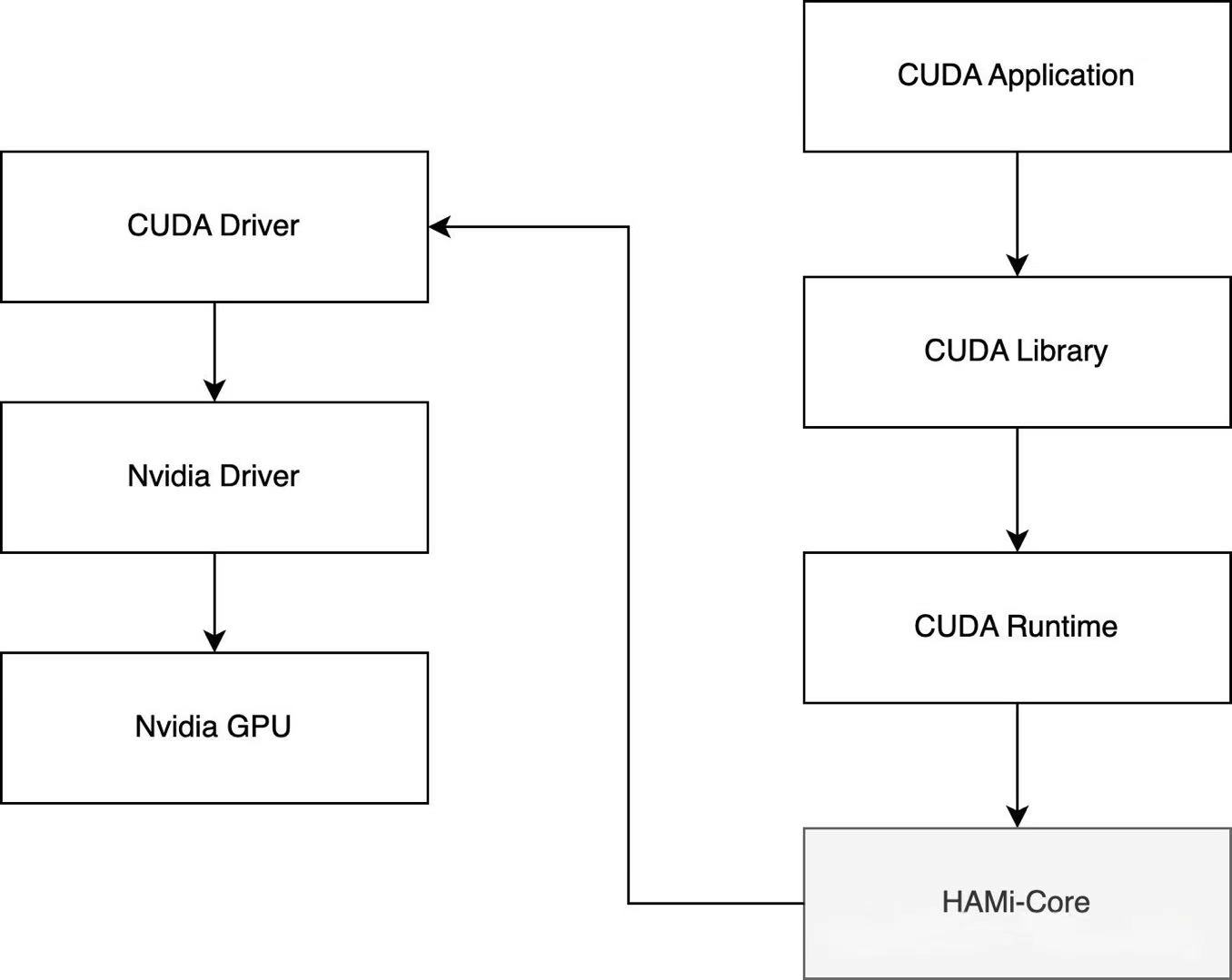
This article primarily addresses the following questions:
- How does
libvgpu.sotake effect? - How are CUDA APIs intercepted?
- How is GPU memory limited?
- How is GPU core limited?
I'm not very familiar with C, so if I've made any mistakes, please leave a comment to correct them!
TL;DR
How does libvgpu.so take effect?
- The device plugin, in its
Allocatemethod, useshostPathto mountlibvgpu.sofrom the host machine into the Pod. - It then uses the
LD_PRELOADmechanism to ensure thelibvgpu.solibrary mounted in the previous step is loaded first, making it effective.
How are CUDA APIs intercepted?
- By overwriting the
dlsymfunction to hijack calls to NVIDIA's dynamic libraries (like CUDA and NVML), specifically intercepting functions starting withcuandnvml.
How is GPU memory limited?
- First, it intercepts
_nvmlDeviceGetMemoryInfofrom the NVML API. This makes thenvidia-smicommand only display the memory requested by the application (derived fromCUDA_DEVICE_MEMORY_LIMIT_X). - Then, it intercepts memory allocation-related CUDA APIs, such as
cuMemoryAllocateandcuMemAlloc_v2. - Before allocating memory, an
oom_checkis added. If the Pod's current GPU memory usage exceeds the specified limit (fromCUDA_DEVICE_MEMORY_LIMIT_X), it directly returns an OOM error.
How is GPU core limited?
- Similarly, it intercepts CUDA APIs related to submitting kernels, such as
cuLaunchKernel. - Before submitting a kernel, a
rate_limitlogic is added. The algorithm is similar to a token bucket. Each kernel submission consumes a token. When a submission finds no available tokens, it will sleep directly. After a period, tokens are replenished, and tasks can be submitted again. - The
CUDA_DEVICE_SM_LIMITenvironment variable is used when replenishing tokens.
1. How libvgpu.so Takes Effect
- How is it mounted into the Pod?
- How is it put to use?
How it's mounted into the Pod
This part is handled by the hami-device-plugin-nvidia component, specifically in the Allocate method. The relevant code is as follows:
// pkg/device-plugin/nvidiadevice/nvinternal/plugin/server.go#L385
func (plugin *NvidiaDevicePlugin) Allocate(ctx context.Context, reqs *kubeletdevicepluginv1beta1.AllocateRequest) (*kubeletdevicepluginv1beta1.AllocateResponse, error) {
    // ...
    // Some logic omitted for brevity
    // ...
    response.Mounts = append(response.Mounts,
        &kubeletdevicepluginv1beta1.Mount{ContainerPath: fmt.Sprintf("%s/vgpu/libvgpu.so", hostHookPath),
            HostPath: hostHookPath + "/vgpu/libvgpu.so",
            ReadOnly: true},
        // ... other mounts
    )
    // ...
}
The core part:
response.Mounts = append(response.Mounts,
    &kubeletdevicepluginv1beta1.Mount{
        ContainerPath: fmt.Sprintf("%s/vgpu/libvgpu.so", hostHookPath),
        HostPath:      hostHookPath + "/vgpu/libvgpu.so",
        ReadOnly:      true,
    },
)
There is an operation to mount libvgpu.so using HostPath, sourced from an environment variable. In HAMI deployments, /usr/local is used by default.
How it's loaded
In the hami-device-plugin-nvidia Allocate method, there's also this piece of logic:
found := false
for _, val := range currentCtr.Env {
    if strings.Compare(val.Name, "CUDA_DISABLE_CONTROL") == 0 {
        // If the environment variable exists but is false or fails to parse, ignore it
        t, _ := strconv.ParseBool(val.Value)
        if !t {
            continue
        }
        // Only mark as "found" if the environment variable exists and is true
        found = true
        break
    }
}
if !found {
    response.Mounts = append(response.Mounts,
        &kubeletdevicepluginv1beta1.Mount{
            ContainerPath: "/etc/ld.so.preload",
            HostPath:      hostHookPath + "/vgpu/ld.so.preload",
            ReadOnly:      true,
        },
    )
}```
When the `CUDA_DISABLE_CONTROL=true` environment variable is not manually set to disable HAMI's isolation, the file `/usr/local/vgpu/ld.so.preload` from the host is mounted to `/etc/ld.so.preload` inside the Pod.

In Linux systems, `/etc/ld.so.preload` is a special file. The system will prioritize loading the shared libraries listed in this file when loading shared libraries. This file is typically used to force the loading of specific shared libraries, overriding the default dynamic linking behavior during system startup or program execution.
> The dynamic library loading order in Linux is: `LD_PRELOAD` > `LD_LIBRARY_PATH` > `/etc/ld.so.cache` > `/lib` > `/usr/lib`.

Using `LD_PRELOAD` ensures that our custom `libvgpu.so` is loaded.

Let's check the contents of this file on the host:
```console
root@j99cloudvm:~/lixd/hami# ls /usr/local/vgpu
containers  ld.so.preload  libvgpu.so

root@j99cloudvm:~/lixd/hami# cat /usr/local/vgpu/ld.so.preload
/usr/local/vgpu/libvgpu.so
The content is /usr/local/vgpu/libvgpu.so, which means this file ensures that the libvgpu.so we mounted from the outside is loaded with priority.
In short: It uses the LD_PRELOAD method to load its own implementation of libvgpu.so.
Core & Memory Thresholds
How does libvgpu.so know what limits to set for core and memory?
This is also handled in the hami-device-plugin-nvidia Allocate method. Allocate injects the relevant environment variables into the Pod: CUDA_DEVICE_MEMORY_LIMIT and CUDA_DEVICE_SM_LIMIT.
for i, dev := range devreq {
    limitKey := fmt.Sprintf("CUDA_DEVICE_MEMORY_LIMIT_%v", i)
    response.Envs[limitKey] = fmt.Sprintf("%vm", dev.Usedmem)
}
response.Envs["CUDA_DEVICE_SM_LIMIT"] = fmt.Sprint(devreq.Usedcores)
This way, libvgpu.so knows what limits to enforce.
Summary
This section analyzed how libvgpu.so takes effect.
- When
hami-device-plugin-nvidiastarts, it copieslibvgpu.sofrom its image to the host, by default at/usr/local/vgpu/libvgpu.so. - When a Pod is created, the
Allocatemethod inhami-device-plugin-nvidiauseshostPathto mount the/usr/local/vgpu/libvgpu.sofile from the host into the Pod. - Simultaneously, it uses
/etc/ld.so.preloadto prioritize loading thelibvgpu.solibrary mounted in the previous step. This is also done in theAllocatemethod by mounting/usr/local/vgpu/ld.so.preloadfrom the host to/etc/ld.so.preloadin the Pod.
With this, we have achieved priority loading of our custom libvgpu.so when loading shared libraries in the Pod.
2. How CUDA APIs are Intercepted
This section analyzes how HAMI-Core (libvgpu.so) intercepts CUDA APIs.
Overwriting the dlsym function to intercept CUDA APIs
Overwriting the dlsym function
dlsym is a function used for symbol resolution, declared in the dlfcn.h header file, applicable to Linux and other POSIX-compliant systems. It allows a program to dynamically load and use symbols from shared libraries at runtime.
HAMi-core overwrites the dlsym function to hijack calls to NVIDIA's dynamic libraries (like CUDA and NVML), specifically intercepting functions starting with cu and nvml.
- Initialize
dlsym. - If the symbol starts with
cu, handle it specially using__dlsym_hook_section(handle, symbol). - If it starts with
nvml, handle it specially using__dlsym_hook_section_nvml(handle, symbol). - Finally, if nothing was found before, use the real
dlsym.
The complete code is as follows:
// src/libvgpu.c#L77-L116
FUNC_ATTR_VISIBLE void* dlsym(void* handle, const char* symbol) {
    pthread_once(&dlsym_init_flag, init_dlsym);
    LOG_DEBUG("into dlsym %s", symbol);

    /* 1. Initialize real_dlsym */
    // ... initialization logic ...

    /* 2. Special handling for cu* symbols */
    if (symbol == 'c' && symbol == 'u') {
        pthread_once(&pre_cuinit_flag, (void(*)(void))preInit);
        void* f = __dlsym_hook_section(handle, symbol);
        if (f != NULL)
            return f;
    }

    /* 3. Special handling for nvml* symbols */
#ifdef HOOK_NVML_ENABLE
    if (symbol == 'n' && symbol == 'v' && symbol == 'm' && symbol == 'l') {
        void* f = __dlsym_hook_section_nvml(handle, symbol);
        if (f != NULL)
            return f;
    }
#endif

    /* 4. Other symbols go through the original dlsym */
    return real_dlsym(handle, symbol);
}
Handling cu functions: __dlsym_hook_section
__dlsym_hook_section defines how to handle symbols starting with cu.
__dlsym_hook_section_nvmlis similar, so it won't be detailed here.
void* __dlsym_hook_section(void* handle, const char* symbol) {
    int it;

    /* 1. Check if the symbol is in the list of CUDA APIs to be intercepted */
    for (it = 0; it < CUDA_ENTRY_END; it++) {
        if (strcmp(cuda_library_entry[it].name, symbol) == 0) {
            if (cuda_library_entry[it].fn_ptr == NULL) {
                LOG_WARN("NEED TO RETURN NULL");
                return NULL;
            } else {
                break;
            }
        }
    }

    /* 2. Fill the hooked function pointer through macro definitions */
    /* Context */
    DLSYM_HOOK_FUNC(cuCtxGetDevice);
    DLSYM_HOOK_FUNC(cuCtxCreate);
    /* ... */
    DLSYM_HOOK_FUNC(cuGraphDestroy);

#ifdef HOOK_MEMINFO_ENABLE
    DLSYM_HOOK_FUNC(cuMemGetInfo_v2);
#endif

    /* 3. Return NULL if not found */
    return NULL;
}```
The core logic is in `DLSYM_HOOK_FUNC`.

### `DLSYM_HOOK_FUNC` Macro Definition
```c
#define DLSYM_HOOK_FUNC(f)                                           \
    if (0 == strcmp(symbol, #f)) {                                   \
        return (void*) f; }                                          \
#f: This is a special preprocessor operator in the macro that converts the passed parameterfinto a string literal. For example,#fconvertscuGraphDestroyinto the string"cuGraphDestroy".strcmp(symbol, #f): Ifsymbolmatches the string#f,strcmpreturns 0.return (void*) f;: Ifstrcmpreturns 0, it returns the function pointer corresponding tof.
For example, DLSYM_HOOK_FUNC(cuGraphDestroy); expands to:
if (0 == strcmp(symbol, "cuGraphDestroy")) {
    return (void*) cuGraphDestroy;
}
hook.c
This file uses dlopen and dlsym to load the CUDA library and redirect CUDA function calls to achieve interception, monitoring, or modification of CUDA function behavior.
First, cuda_library_entry defines which CUDA functions need to be intercepted. Then, load_cuda_libraries uses dlopen to open libcuda.so.1 and real_dlsym to find the address of each function by name and store it in cuda_library_entry.
libcuda_hook.h
src/include/libcuda_hook.h contains the actual interception implementation for the CUDA functions obtained in the previous step. The basic principle is to redirect CUDA function calls through function pointers.
The CUDA_OVERRIDE_CALL macro redirects the CUDA function call via the function pointer in the table. CUDA_FIND_ENTRY finds the corresponding function pointer in the table based on the passed function enum.
Summary
This section explained how HAMI-Core (libvgpu.so) intercepts CUDA APIs. The core mechanism is to overwrite the dlsym function and replace function addresses.
3. How GPU Memory is Limited
This section analyzes how HAMI-Core implements the memory limit. This is divided into two parts: NVML interception and CUDA API interception.
NVML
When we request 3000MB of memory, running nvidia-smi inside the Pod shows exactly 3000MB. This is achieved by intercepting the _nvmlDeviceGetMemoryInfo API from NVML.
The intercepted function (_nvmlDeviceGetMemoryInfo) gets the limit from the CUDA_DEVICE_MEMORY_LIMIT_X environment variable and modifies the total, free, and used fields of the returned nvmlMemory_t struct to reflect the virtual limit, not the actual hardware memory.
The limit is read from the environment during initialization and stored in a shared memory region.
CUDA
cuMemAlloc_v2
HAMi-Core re-implements relevant methods. For example, cuMemAlloc_v2 eventually calls add_chunk, which contains a custom validation logic:
if (oom_check(dev, size)) {
    return -1;
}
oom_check
oom_check's implementation:
int oom_check(const int dev, size_t addon) {
    // ...
    uint64_t limit = get_current_device_memory_limit(d);
    size_t _usage = get_gpu_memory_usage(d);

    if (limit == 0) {
        return 0;
    }

    size_t new_allocated = _usage + addon;
    if (new_allocated > limit) {
        LOG_ERROR("Device %d OOM %zu / %zu", d, new_allocated, limit);

        // ... try to clean up resources from quit processes ...

        return 1;
    }
    return 0;
}
If the new allocation exceeds the limit, it will eventually return 1, causing the allocation to fail with an OOM error. This is how the memory limit is enforced.
4. How GPU Core is Limited
This section analyzes how HAMI-Core implements the core limit.
What is a Kernel?
In CUDA programming, a Kernel is a function executed in parallel on the GPU. The process of launching a kernel is what truly utilizes the GPU.
HAMi-Core limits the submission of kernels to achieve the core limit. The algorithm is similar to a token bucket: each kernel submission consumes a token. If no tokens are available, the process sleeps until tokens are replenished.
cuLaunchKernel
cuLaunchKernel is the CUDA API for launching a kernel. HAMI-Core's custom cuLaunchKernel method adds a rate_limiter logic to implement the core limit.
CUresult cuLaunchKernel(...) {
    ENSURE_RUNNING();
    pre_launch_kernel();
    if (pidfound == 1) {
        rate_limiter(gridDimX * gridDimY * gridDimZ,
                     blockDimX * blockDimY * blockDimZ);
    }
    CUresult res = CUDA_OVERRIDE_CALL(cuda_library_entry,
                                      cuLaunchKernel,
                                      ...);
    return res;
}
Core Logic: rate_limiter
The rate_limiter compares the current usage with the limit obtained from the environment variable. Each kernel submission decrements g_cur_cuda_cores. If it falls below zero, the process is blocked (nanosleep). In the next time slice, g_cur_cuda_cores is restored.
void rate_limiter(int grids, int blocks) {
    // ...
    if ((get_current_device_sm_limit(0) >= 100) || (get_current_device_sm_limit(0) == 0))
        return;
    // ...
    do {
CHECK:
        before_cuda_cores = g_cur_cuda_cores;
        LOG_DEBUG("current core: %d", g_cur_cuda_cores);
        if (before_cuda_cores < 0) {
            nanosleep(&g_cycle, NULL);
            goto CHECK;
        }
        after_cuda_cores = before_cuda_cores - kernel_size;
    } while (!CAS(&g_cur_cuda_cores, before_cuda_cores, after_cuda_cores));
}
The limit is obtained from the CUDA_DEVICE_SM_LIMIT environment variable. The do-while loop with CAS (Compare And Swap) ensures that the token update is atomic. The sleep duration is a constant 10 milliseconds.
Token Replenishment Logic
A background thread running the utilization_watcher function continuously monitors GPU utilization.
void* utilization_watcher() {
    // ...
    int upper_limit = get_current_device_sm_limit(0);
    // ...
    while (1) {
        nanosleep(&g_wait, NULL);
        // ... get current utilization ...
        share = delta(upper_limit, userutil, share);
        change_token(share);
    }
}
It calculates how many tokens to add back in each cycle using the delta function and then calls change_token to replenish the tokens. The delta function calculates the increment based on the difference between the target utilization (upper_limit) and the current utilization.
This is consistent with the test results from Open Source vGPU Solution HAMI: Core & Memory Isolation Test, where the GPU utilization might exceed the threshold in the short term, but over a longer period, the average value fluctuates around the threshold.
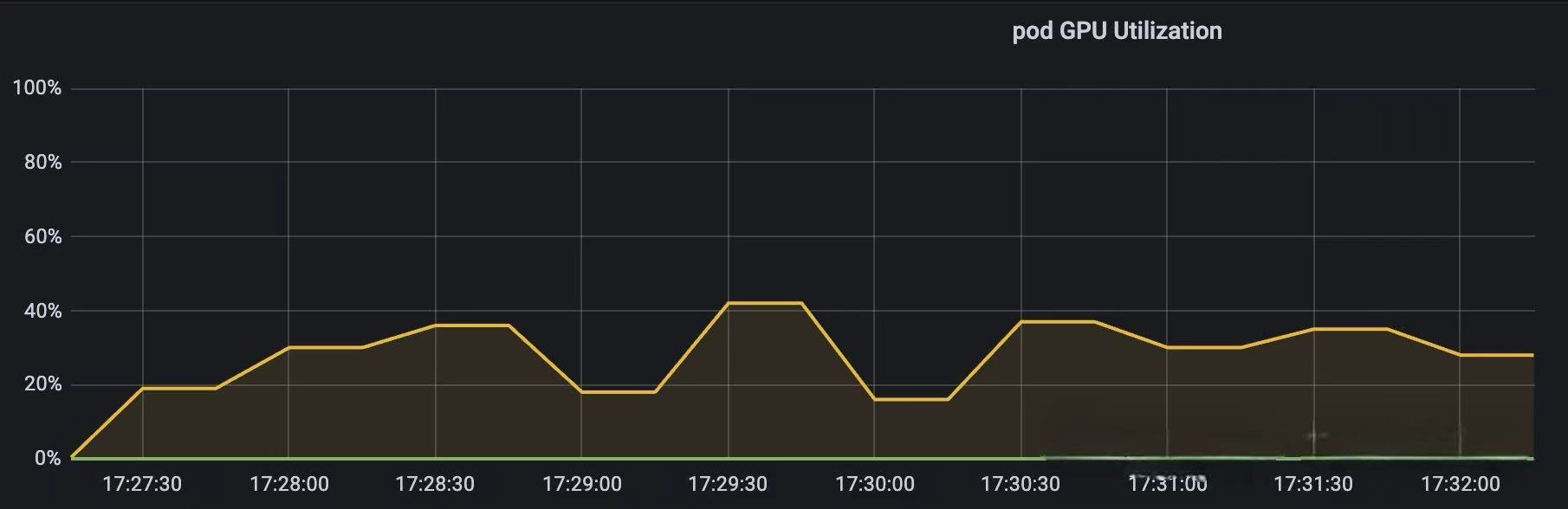
The image above shows the test result when the GPU Core Limit is set to 30.
5. Summary
This article has mainly analyzed the working principle of HAMI-Core. HAMI's compute power limitation uses a token bucket-like mechanism to restrict a process's kernel submissions. Submitting a GPU task consumes a token. Once the tokens are exhausted, submission is blocked until tokens are replenished in the next round.
Now we can answer the questions from the beginning
How does libvgpu.so take effect?
- The device plugin uses
hostPathto mountlibvgpu.sofrom the host into the Pod. - It uses the
LD_PRELOADmechanism to prioritize the loading of the mountedlibvgpu.solibrary. - It specifies the Memory and Core thresholds by injecting the
CUDA_DEVICE_MEMORY_LIMIT_XandCUDA_DEVICE_SM_LIMITenvironment variables.
How are CUDA APIs intercepted?
- By overwriting the
dlsymfunction to hijack calls to NVIDIA's dynamic libraries (like CUDA and NVML), specifically intercepting functions starting withcuandnvml.
How is GPU memory limited?
- First, it intercepts
_nvmlDeviceGetMemoryInfofrom the NVML API to makenvidia-smidisplay the requested memory (fromCUDA_DEVICE_MEMORY_LIMIT_X). - Then, it intercepts memory allocation-related CUDA APIs like
cuMemoryAllocateandcuMemAlloc_v2. - Before allocating memory, an
oom_checkis performed. If the Pod's current GPU memory usage exceeds the limit (fromCUDA_DEVICE_MEMORY_LIMIT_X), it directly returns an OOM error.
How is GPU core limited?
- Similarly, it intercepts CUDA APIs related to kernel submission, such as
cuLaunchKernel. - Before submitting a kernel, a
rate_limitlogic is added. The algorithm is like a token bucket. Each kernel submission consumes a token. When no tokens are available, the process sleeps. After a period, tokens are replenished, and tasks can be submitted again. - The
CUDA_DEVICE_SM_LIMITenvironment variable is used when replenishing tokens.
To learn more about the HAMI project, please visit the GitHub repository or join our Slack community.