HAMi 2.10 Deep Dive (Part 3): Exclusive, Binpacked, and NUMA-Aligned — Scheduling Policies Are Now Composable
Inference replicas want tight binpacking, multi-GPU Pods want the same NUMA node for bandwidth, and latency-sensitive workloads want whole GPUs to themselves — three policies in one sentence, and you used to have to pick just one. In the third article of our HAMi 2.10 deep-dive series, we explain the filter-then-sort evaluation model and verify each step with a real selection path across four T4s.
The first two articles in this series covered HAMi's integration with external schedulers: KAI Scheduler for NVIDIA GPUs (Part 1) and Volcano for Ascend NPUs (Part 2). This article returns to HAMi's own scheduler for another easily overlooked but very practical v2.10.0 feature: composable scheduling policies.
HAMi has long offered per-Pod GPU scheduling policies via the hami.io/gpu-scheduler-policy annotation: binpack stacks workloads onto fewer cards, spread scatters them, and the new-in-v2.10.0 mutex demands a card of its own. But before v2.10.0, the annotation accepted only one value.
Real clusters rarely need just one behavior. A typical production wish list: inference replicas should binpack tightly to leave whole cards free; each Pod's multiple GPUs should land on the same NUMA node for bandwidth; and the latency-sensitive batch should have a few cards entirely to itself. Three policies in a single sentence. Before v2.10.0, you picked one and gave up the rest.
v2.10.0 completes the puzzle: hami.io/gpu-scheduler-policy now accepts an ordered, comma-separated list, and filter-type and scoring-type policies can be combined (PR #2621 by @mesutoezdil, closing issue #2010):
# Exclusive GPU first, then binpack, with NUMA as the tiebreaker
metadata:
  annotations:
    hami.io/gpu-scheduler-policy: "mutex,binpack,numa"
Two Kinds of Policies: Filters and Sort Keys
The key to understanding this feature is recognizing that HAMi's GPU policies were never the same kind of thing — they play two different roles:
| Policy | Role | What it does |
|---|---|---|
mutex | Filter | Only cards with zero workloads are candidates; every occupied card is removed |
topology-aware | Filter (NVIDIA only) | Keeps only cards whose NVLink/NVSwitch topology satisfies the multi-GPU request; requires topology-aware scheduling to be enabled |
binpack | Sort key | Prefers the most-utilized qualified card, concentrating workloads |
spread | Sort key | Prefers the least-utilized qualified card, scattering workloads |
numa | Sort key | Prefers cards on lower-numbered NUMA nodes, improving locality |
A filter answers a yes/no question per card: can this card participate at all? A sort key answers a ranking question: among qualified cards, who comes first? The two roles don't conflict, which is exactly why they compose: filters run first and shrink the candidate set; sort keys then rank the survivors.
How the Scheduler Evaluates a Policy Chain
When filtering and scoring a node's GPUs, the HAMi scheduler evaluates the policy chain as a fixed pipeline:

The rules, in order:
- Parse. The annotation is split on commas, surrounding whitespace per item is ignored, duplicates are dropped, and only known policy names take effect.
- Filter first.
mutexandtopology-awareapply before any sorting. For a Pod withmutex, exactly one question decides whether a card qualifies: does this card currently have zero tenants? Even a card running one tiny workload with plenty of free memory is excluded entirely. When every card has a tenant, the Pod stays Pending with reasonExclusiveDeviceAllocateConflict. - Sort in written order.
binpack,spread, andnumaform an ordered list of sort keys. The first key dominates:binpack,numasorts by binpack, and only when binpack scores two cards equally does the NUMA node number break the tie;numa,binpackreverses the precedence. The order of the list is the order of the keys. - Deterministic tiebreak. If two cards compare equal under every key in the chain, the smaller device index wins. So on an idle cluster, identical requests produce identical, reproducible placements.
- Filters-only fallback. A chain containing no sort keys at all (e.g.
"mutex,topology-aware") falls back tospreadordering after filtering. - Single-value behavior unchanged. A bare
"binpack","spread", or"mutex"behaves exactly as before v2.10.0; existing workloads need no changes on upgrade.
What the Sort Keys Actually Compare
For binpack and spread, "fullest/emptiest" is not a guess: the scheduler computes a utilization score per card from its allocated compute and memory, with weights across slot, core, and memory (adjustable per Pod via the hami.io/device-scoring-weights annotation). binpack picks the highest-scoring card, spread the lowest. The numa key compares the NUMA node number each card reports via NVML.
Worth noting: v2.10.0 also fixed a related long-standing issue (PR #2012): previously, even with pure binpack/spread, NUMA was the primary sort key, pinning workloads to one NUMA node regardless of actual utilization. After the fix, utilization score is the primary key and NUMA only breaks ties — which is precisely the tiebreaker role numa plays in a policy chain.
Worked Example: One Pod's Selection Path Across Four Cards
Put the flow into a real scenario: one node, four Tesla T4s, and a Pod annotated mutex,binpack requesting 1 vGPU (a 1000 MiB slice). Each card is labeled with its tenant count and utilization score; the arrows are the selection path:
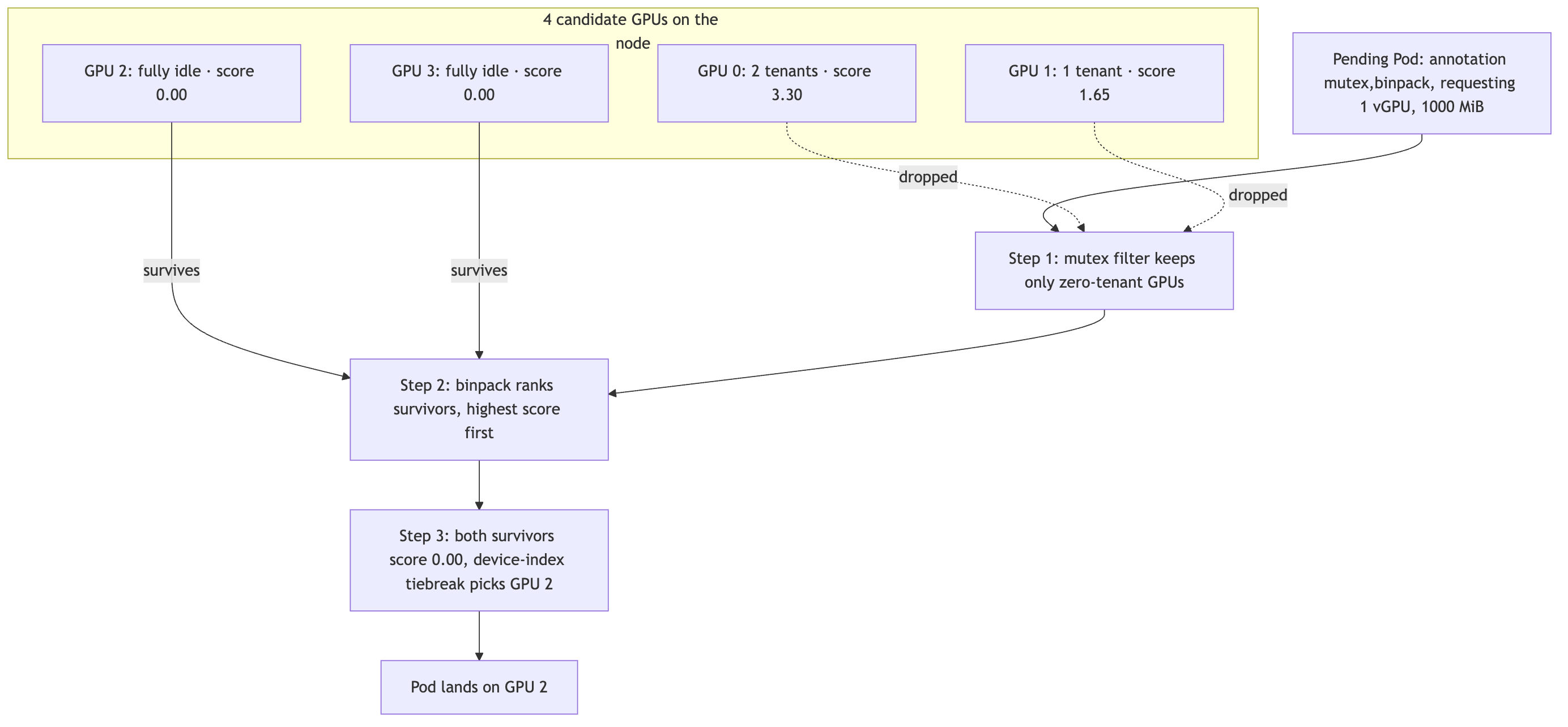
Two things to read from the diagram:
- The busiest GPU 0 never reaches the sorting step: the
mutexfilter removed it first, even though purebinpackwould have chosen it with the top score of 3.30. Filtering precedes sorting; the composed chain never considers the card purebinpackwould pick. - The two survivors score the same (both 0.00),
binpackcan't distinguish them, and the chain falls through to the device-index tiebreak, deterministically choosing GPU 2.
These numbers come from a real test: a card with one 1000 MiB tenant scored 1.651042 and an idle card scored 0.000000, both straight from the scheduler's scoring logs.
Common Recipes
| Annotation | Meaning |
|---|---|
"binpack" | Stack this Pod onto the busiest card that fits, maximizing whole-card idle |
"spread" (default) | Place on the emptiest card, minimizing neighbor contention |
"mutex" | Demand a card with zero current users |
"binpack,numa" | Binpack; on a binpack tie, prefer the lower NUMA node |
"mutex,binpack" | Exclusive and compact: among idle cards pick the busiest, reducing fragmentation |
"mutex,binpack,numa" | The "latency tier" recipe: exclusive card, binpack among idle cards, NUMA as tiebreaker |
An important note on mutex semantics: it guarantees the card has zero users at placement time; ordinary Pods scheduled later may still join the card. To keep a card exclusive for a workload's entire lifetime, request all of its resources (memory and compute), or pin it explicitly with nvidia.com/use-gpuuuid.
Getting Started in Three Steps
1. Upgrade to HAMi v2.10.0 or later:
helm repo add hami-charts https://project-hami.github.io/HAMi/
helm repo update
helm upgrade hami hami-charts/hami -n kube-system --version 2.10.0
Cluster-level defaults remain binpack for node selection and spread for card selection; upgrading changes no defaults.
2. Annotate the Pods that need combined behavior:
apiVersion: v1
kind: Pod
metadata:
  name: inference-latency-tier
  annotations:
    hami.io/gpu-scheduler-policy: "mutex,binpack,numa"
spec:
  containers:
    - name: app
      image: ubuntu:22.04
      command: ["bash", "-c", "sleep 86400"]
      resources:
        limits:
          nvidia.com/gpu: 1      # 1 vGPU
          nvidia.com/gpumem: 8000 # 8000 MiB memory quota
3. Verify the decision. The scheduler writes the chosen card onto the Pod, so you can verify placement without entering the container:
# Chosen card's device UUID, vendor, memory slice, and compute percentage
kubectl get pod inference-latency-tier \
  -o jsonpath='{.metadata.annotations.hami\.io/vgpu-devices-allocated}'; echo
For a mutex Pod stuck Pending, kubectl describe pod shows reason ExclusiveDeviceAllocateConflict; the scheduler also emits one utilization-scoring log line per candidate card while filtering (computer score is), letting you observe exactly how binpack and spread rank:
kubectl -n kube-system logs deploy/hami-scheduler -c vgpu-scheduler-extender \
  --tail=-1 | grep 'computer score' | tail
Try It on a Real Cluster
Reading about filters and sort keys is one thing; watching a mutex Pod stay Pending until you free a card, and watching mutex,binpack refuse the card pure binpack would have picked, is another. Lab 14 runs the full feature matrix on a GKE node with four Tesla T4s: default spread, binpack stacking, mutex blocking and release, and combined mutex,binpack behavior — all verified via allocation annotations, events, and scheduler logs.
Summary
- HAMi's GPU scheduling policies come in two kinds:
mutex/topology-awareare filters (who gets to compete), andbinpack/spread/numaare sort keys (who ranks first); the two kinds compose naturally; - v2.10.0 lets the annotation accept an ordered comma-separated list, evaluated as "filter first, then sort in written order, device index breaks ties," with single-value behavior identical to before the upgrade;
- A related old NUMA-as-primary-key issue was fixed along the way, returning
numato its tiebreaker role — utilization score is the primary key.
In one sentence: HAMi's scheduling policies went from a multiple-choice question to a recipe.
Author: Jimmy Song (宋净超), Dynamia AI.
Series Reading
- Previous: HAMi 2.10 Deep Dive (Part 2): One Ascend Card, Two Pods — Testing Volcano + HAMi-core vNPU Soft Slicing
- Part 1: HAMi 2.10 Deep Dive (Part 1): Tested — KAI Scheduler + HAMi GPU Memory Hard Isolation
- HAMi v2.10.0 Release: Flexible MIG, Composable Scheduling Policies, and a Broader Accelerator Ecosystem
- Hands-on lab: Lab 14: Validating Composable Scheduling Policies on GKE
References
- Original post on the HAMi website: https://project-hami.io/blog/composable-scheduler-policies
- HAMi v2.10.0 release announcement: https://project-hami.io/blog/hami-v2-10-0-release
- Lab 14 tutorial (full reproduction steps on GKE): https://project-hami.io/tutorials/labs/composable-scheduler-policies-gke
- PR #2621 (comma-separated gpu-scheduler-policy): https://github.com/Project-HAMi/HAMi/pull/2621
- Issue #2010 (Composable scheduling policies): https://github.com/Project-HAMi/HAMi/issues/2010
- Scheduling design document: https://project-hami.io/docs/developers/scheduling
- Configuration reference: https://project-hami.io/docs/userguide/configure